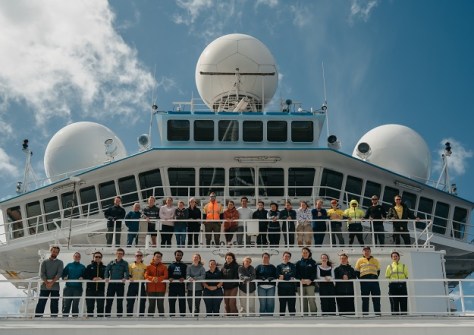
University students from 18 educational institutions across Australia are about to get a taste of working life at sea.
The twenty students departed Fremantle yesterday aboard the CSIRO’s research vessel (RV) Investigator on a 13-day voyage to Hobart.
During the journey, they will be trained on how to use the vessel’s state-of-the-art scientific equipment and conduct science activities such as seafloor mapping, sediment sampling and oceanographic surveys.
The voyage forms part of CAPSTAN — the Collaborative Australian Postgraduate Sea-Training Alliance Network — a national tertiary sea-training initiative.
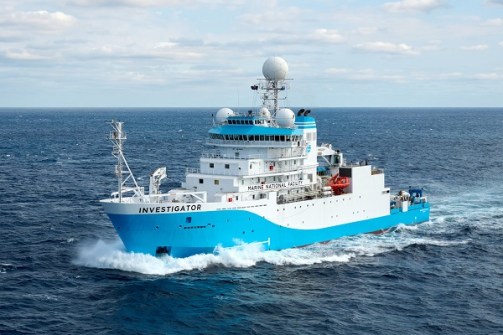
The project is a partnership between the CSIRO, the University of Tasmania’s Institute for Marine and Antarctic Studies (IMAS), and the Australian and New Zealand International Scientific Drilling Consortium (ANZIC).
Life-changing experience
According to CAPSTAN Director, Dr Pier van der Merwe from IMAS, the experience will be invaluable for developing Australia’s next generation of marine experts.
“You can teach the theory in a classroom, but it’s when students are out on the water that the pieces start to fall into place,” Dr van der Merwe said.
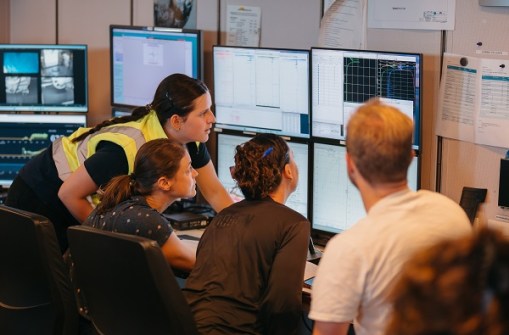
“They see the conditions scientists work in, the technology used to collect data, and how teams collaborate to solve research questions.
“For many students, being part of the CAPSTAN program is a life-changing experience that often shapes the direction of their careers.”
Shipwreck survey
One of the activities the students will undertake, in collaboration with the CSIRO technical team, will be a survey of an historic shipwreck on behalf of the federal government’s Department of Climate Change, Energy, Environment and Water’s Underwater Cultural Heritage team.
That ship is the 152-metre-long ocean liner and refrigerated cargo ship, the SS Pericles, which hit an uncharted rock and sank off Cape Leeuwin, Western Australia on 31 March 1910. Fortunately, no lives (apart from that of the ship’s cat) were lost.
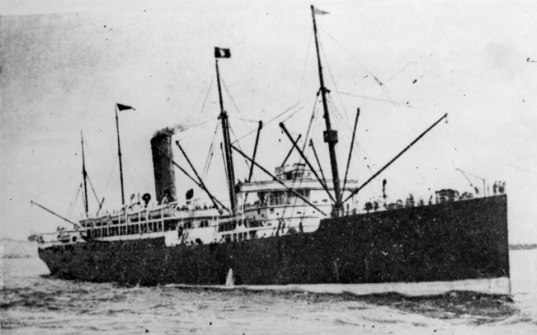
The area had been surveyed in 1900 by the HMS Penguin, which took soundings at intervals of one nautical mile, just missing the rock pinnacle that doomed the Pericles.
Interestingly, the Pericles was built by the same company that built the Titanic. She was fitted with a double bottom and had eight watertight compartments to keep her afloat in the event of a breach.
Unfortunately, the collision damaged the forward plates of her hull, with the result that in less than three minutes, water five metres deep had collected in her forward hold.