New Zealand’s government agency for managing location and property data is actively exploring the use of AI.
Toitū Te Whenua Land Information New Zealand (LINZ) is assessing what the use of AI could mean for the way it processes survey transactions.
According to LINZ, the organisation is “taking a deliberate approach, supported by clear governance, regular risk assessment, and a structured way of testing ideas before anything moves into production”.
Indeed, the use of AI is expanding across New Zealand’s public sector, with a concomitant requirement to ensure that it is applied responsibly.
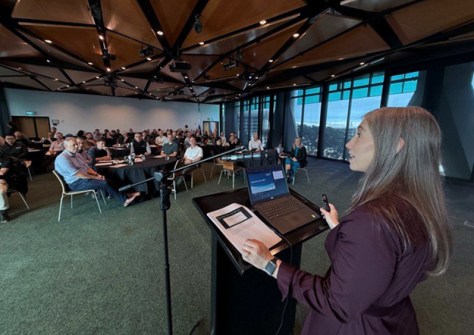
Speaking at a recent Survey and Spatial New Zealand AI workshop, Christina Sophocleous-Jones, Head of Property Rights at LINZ, spoke about initiatives already underway.
Those initiatives include the potential for partially automating routine survey processing, developing an AI‑enabled knowledge base for staff, and employing AI to assist with contact centre work.
One example given demonstrated that AI could substantially reduce the time it took to undertake routine cadastral survey checks. Another showed how LINZ staff can obtain faster, more consistent answers to complex questions, but with experienced people still overseeing and making the final decisions.
Sophocleous-Jones made it clear that AI is there to support the work of humans, not replace expert judgement, and that human supervision will remain fundamental.
Sophocleous-Jones also told the audience that LINZ is working on developing AI tools for internal use first, with possible future integration into the Landonline service.