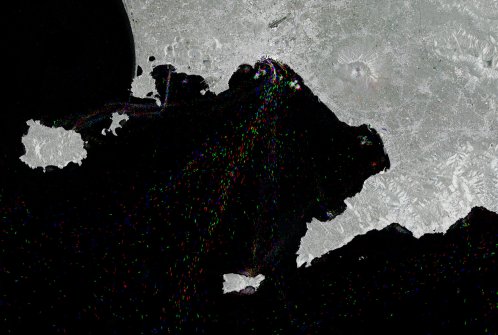
The Sentinel-1D satellite has passed its commissioning phase and is now fully operational.
The synthetic aperture radar Earth observation spacecraft was launched on 4 November 2025, and is the fourth and last in the first generation of Sentinel-1 satellites.
The initial spacecraft, Sentinel-1A, was launched on 3 April 2014 and marked the operational beginning of the Earth observation segment of Copernicus, the European Union’s space program.
As Sentinel-1 is designed as a dual-spacecraft system, spacecraft -1A was joined in orbit by -1B on 25 April 2016. The two satellites circled the Earth in the same orbit but separated by 180 degrees.
Sentinel-1B’s mission ended earlier than planned in 2022 due to an equipment malfunction. It was replaced in 2024 following the launch of Sentinel-1C.
The Sentinel-1D satellite is intended to replace the long-lived -1A, and thereafter will work in tandem with -1C under the same kind of orbital scheme as -1A and -1B.
Multi-mode
The Sentinel-1 spacecraft are 21 metres long, 2.5 metres wide and 4 metres high — figures that encompass two, 10-metre-long solar arrays and a 12-metre-long radar antenna.
They each have a mass of around 2,180 kg and a planned minimum lifetime of seven years.
Equipment carried and capabilities include:
- Primary instrument: C-band synthetic aperture radar operating at 5.405 GHz
- Secondary instrument: Automatic Identification System aboard Sentinel-1C and Sentinel-1D
- Interferometric wide-swath mode at 250 km and 5×20 m spatial resolution
- Wave-mode images of 20×20 km and 5×5 m spatial resolution (at 100 km intervals)
- Strip map mode at 80 km swath and 5×5 m spatial resolution
- Extra wide-swath mode of 400 km and 20×40 m spatial resolution



Next generation
Even though the final Sentinel-1 spacecraft has only just now been commissioned, European authorities are already looking ahead to the series’ replacement.
“Sentinel-1 began as a trailblazer,” said Nuno Miranda, ESA’s Sentinel-1 Mission Manager. “With the successful commissioning of Sentinel-1D, it now stands as a cornerstone — reflecting Europe’s achievements while serving as a launchpad for what comes next.
“For several years, we have been advancing a follow-on mission: Sentinel-1 Next Generation, designed to ensure continuity of measurements well into the mid-2030s and beyond.
“These future satellites are expected to deliver enhanced performance and new capabilities, building on the legacy of their predecessors while addressing emerging scientific and societal needs.”