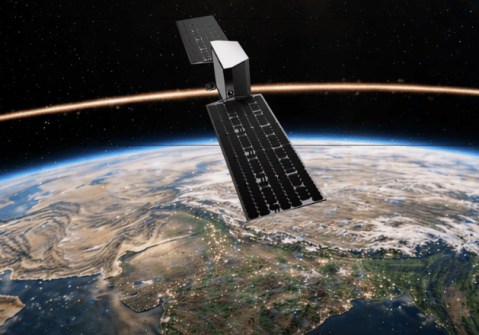
Indian satellite company Pixxel has announced a partnership with Sarvam to develop and build the country’s first ‘orbital data centre’ satellite.
Pixxel will design, build, launch, and operate the Pathfinder satellite, while Sarvam will provide the AI backbone, handling both training and inference directly in orbit, with full-stack language models running on board the satellite.
The Pathfinder, a 200 kg-class satellite, is expected to reach orbit as early as Q4 2026, carrying Pixxel’s flagship hyperspectral imaging camera.
The company’s on-orbit data processing plan follows the trend set by other Earth observation satellite companies, of shifting image processing onto the satellite itself.
Pathfinder will validate real-time AI inference and data processing in the space environment, testing performance, power management, thermal constraints and real-time data workflows under operational conditions.
Orbital data centre
Unlike conventional satellite computing, which relies on low-power edge processors optimised for survival rather than performance, the Pathfinder satellite will host datacentre-class GPUs.
Instead of sending large volumes of raw imagery back to Earth for processing, the system will be able to identify patterns, detect changes and generate insights in real time.
Pixxel says this will significantly reduce the delay between data capture and decision-making.
“Ground-based data centres are facing increasing constraints around energy, land, regulation, and scale, and the current model is becoming harder to sustain environmentally,” said Awais Ahmed, CEO, Pixxel.
“Orbital data centres open up a new frontier, where compute can be powered by abundant solar energy, operate closer to space-based data, and move beyond some of the limits faced on Earth.
“For Pixxel to build the next generation of space infrastructure, we have to help shape this shift, not watch it happen from the sidelines. With Sarvam, this mission is our first step toward making orbital data centres real, operational, and scalable from India.”