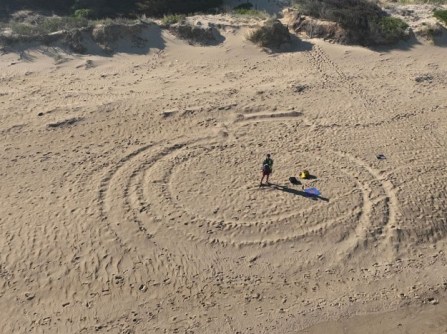
Participants in the Victorian Coastal Monitoring Program are using drones to map and track shoreline changes.
The effort aims to contribute vital information for decision-making regarding management of the state’s beaches and coastline.
The Victorian Coastal Monitoring Program (VCMP) was set up in 2017 in collaboration with citizen scientists and Deakin, Monash and Melbourne Universities.
The project initially aimed to collect and process data to monitor sand movement across 15 Victorian beaches using drones, wave buoys, seafloor mapping and sediment sampling.
Although the program had to be put on pause and moved back into the Department of Energy, Environment and Climate Action (DEECA) during the COVID period, it has since been expanded.
Now, in collaboration with citizen scientists, universities and local government agencies, the VCMP maps more than 40 sites along the Victorian coastline every six to eight weeks.
Dynamic environment
One of those who do the mapping is Rebecca Stuart, Project Manager and Lead Coastal Drone Pilot with DEECA.
She is one of 68 pilots accredited through DEECA’s remotely piloted aircraft system team to use drones for the program.
“This project has such great value,” said Stuart.
“Rising sea levels and more frequent storm events means Victoria’s coastline faces increasing impacts from erosion and inundation.
“The coastline is a dynamic environment and the data captured allows us to highlight hot spots, make comparisons and provide evidence for future management decisions.”
“A dream to map”
Previously a forest and wildlife officer for the Conservation Regulator, Stuart’s background in marine science means the mapping project is a perfect fit for her interests.
“Some places are easier than others to map,” she said.
“For instance, around Patterson Lakes and Sandringham you have planes coming over so you must land regularly.
“Walkerville in contrast is a dream to map.”
According to Stuart, the team tries to map the beaches at times of low tide to capture as much area as possible.
“We also use the drones to monitor storm impacts,” she said.
“Before a storm, we will send a drone up to capture the shoreline before and then map the shoreline after.”
All the data is processed and checked for quality control, and then made available via a publicly accessible online portal.