Spire Global has successfully launched a satellite as part of the MagQuest Challenge.
The MagQuest challenge, run by the US National Geospatial-Intelligence Agency (NGA), aims to advance how Earth’s magnetic field is measured and comes with multi-million-dollar prize awards.
The satellite, launched aboard SpaceX’s Transporter 16 mission, combines Spire’s vertically integrated satellite infrastructure with SBQuantum’s first-of-its-kind diamond quantum magnetometer system.
The result is what Spire says is a novel, commercial approach to geomagnetic data collection and demonstrate diamond-powered geomagnetic data collections from low Earth orbit (LEO).
As Spatial Source reported in January, organisations such as the US Department of War are looking at ways to use the Earth’s magnetic field navigation purposes.
Essential systems
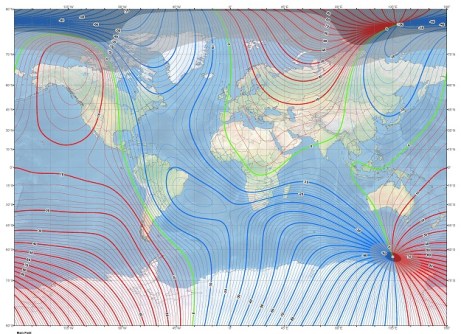
MagQuest is a multi-phase open innovation challenge designed to evaluate new ideas to increase the efficiency, reliability, and sustainability of geomagnetic data for the World Magnetic Model (WMM), the representation of the Earth’s magnetic field.
The WMM is currently used in essential public and military systems, including mobile navigation applications, surveying tools, antennas, solar panels and GPS.
“Reliable positioning, navigation, and timing is a growing priority, particularly in GPS-degraded environments,” said Quintin Jones, Vice President and Head of North America at Spire Global.
“Through the MagQuest challenge, we’re demonstrating how commercial satellite infrastructure can support new approaches to geomagnetic data collection and help advance technologies used by millions every day.”
Continuous monitoring
“With the help of our partners at Spire, our device will relay continuous monitoring of the Earth’s magnetic field down from space, providing crucial data to power the World Magnetic Model and all electronic compasses, including those found in smartphones,” said David Roy-Guay, Founder of SBQuantum.
Spire and SBQuantum will demonstrate operations of the satellite system and provide data to NOAA’s National Centers for Environmental Information and NASA’s Goddard Space Flight Center for assessment. There may be an opportunity for additional funding at the end of the challenge to sustain operations and data provisions beyond the three-year period.
The results of MagQuest will inform NGA’s acquisition strategy for a WMM global magnetic field data collection capability.