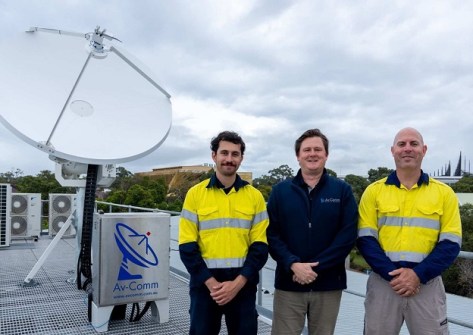
Edith Cowan University has a new satellite ground station for use in teaching, space research and satellite-based Earth observation.
The facility at ECU’s Joondalup campus is the only one of its kind at a Western Australia university.
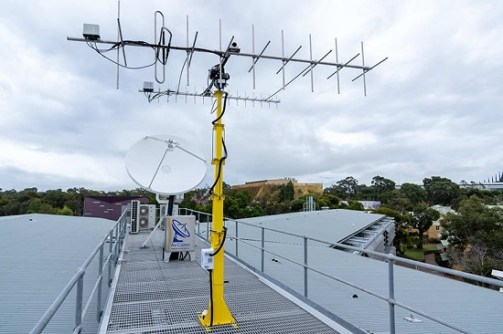
Equipped with a 2.4-metre-diameter satellite dish, the station will enable real-time tracking and communications with low Earth orbit satellites, providing students and researchers access to defence and space technologies, mission operations and data streams that were previously out of reach.
The facility contributes to the Western Australian Space Industry Strategy 2024-30 and will eventually support Stage 2 of NASA’s IGNIS Mission to map and monitor thermal activity and lightning patterns.
“We are thrilled to bring this advanced space capability to Edith Cowan University,” said Associate Professor Leslie Sikos, ECU’s Associate Dean of Computing and Security.
“The facility incorporates the latest design and most sophisticated technology, achieving the goals of tracking satellites, conducting earth observation and satellite communications.”
The equipment was installed by Australian communications company, Av-Comm Space and Defence.
Survey to set up IGNIS lightning detection network
Spatial Source has reported before on the IGNIS project and the work being done in Western Australia.
IGNIS is an international collaboration involving ECU, NASA and other Australian universities including the University of New South Wales, the University of Adelaide, the University of Technology Sydney, and the University of Newcastle.
The project aims to achieve real-time lightning detection and provide firefighters with earlier warnings.
Early last year saw the completion of an aerial survey in Western Australia, designed to map out locations for a lightning detection network.
“The airborne part of this study has just completed 10 flying days, that’s more than 50 flying hours, covering 10,000 kilometres — which is the equivalent to one million hectares or 2.2 million acres,” IGNIS Project Lead and ECU Executive Dean, Professor Paulo de Souza, told Spatial Source at the time.
“This project could take several years to complete but could change the way lightning is studied well into the future and could potentially change the way fires are fought not only in Australia, but around the world,” Professor de Souza added.
Student involvement in space and Earth research
From 1 July this year, 148 students from 26 schools will embark on an immersive STEM program in the form of ECU’s second IGNIS Internship Program.
Designed for students in years 7 to 11, the program offers an opportunity for them to contribute to real-world research in partnership with NASA.
“It’s incredibly exciting to be giving students the chance to get involved in hands-on STEM research that’s happening right here in Western Australia,” said ECU IGNIS Workshop Coordinator from the School of Engineering, Daizee Wiles.
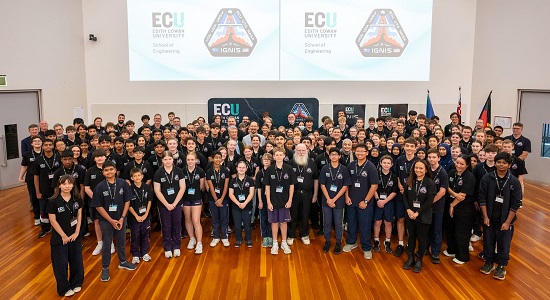
The program was officially launched at ECU earlier this month, when students took part in a full day of on-campus activities.
“What’s most important to us is that the students left excited and inspired,” Ms Wiles said.
“We had students coming up to us afterwards and teachers emailing to say how much they enjoyed it. That excitement is what this program is all about.”
A future stage of the project will see the launch of a CubeSat satellite into low Earth orbit to monitor lightning and thermal patterns from space.