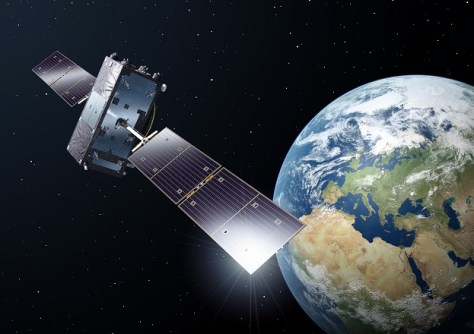
Following their launch at the end of last year, the latest two Galileo GNSS satellites have been formally commissioned into service.
Satellites 33 and 34 were launched aboard an Ariane 6 rocket on 16 December from the European spaceport in French Guiana.
According to the European Space Agency, the launch achieved the most precise orbital injection yet for the Galileo program.
In the hours after launch, mission operators at the Galileo Control Centre in Germany began switching on systems, pointed the satellites toward Earth and initiated the slow drift to their final orbits 23,222 kilometres above the planet.
This was followed by the months-long commission phase, during which the navigation payload, transponders and atomic clocks were configured and validated.
The EU Space Programme Security Accreditation Board formally authorised the entry into service of SAT 33 in May, with SAT 34 following on 23 July.
More Galileo satellites to come
The first operational Galileo satellites were launched from French Guiana in 2011, aboard a Russian-designed Soyuz rocket.
Subsequent Galileos were launched first aboard more Soyuz launch vehicles, then by the European Ariane 5, then back to Soyuz, then the SpaceX Falcon 9, and finally the Ariane 6.
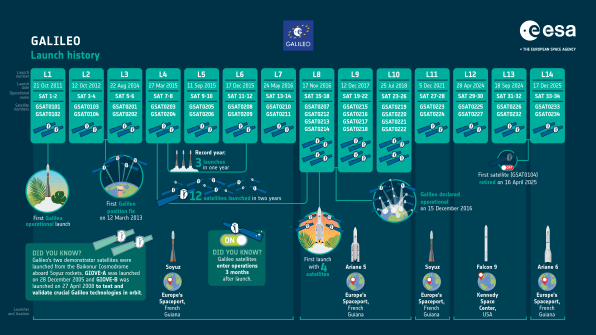
Four more first-generation Galileo satellites are still to be launched, with two of them due for launch by the end of this year.
Meanwhile, as Spatial Source reported in June, work is progressing on Galileo’s second generation of satellites. They will feature:
- Inter-satellite radio links
- Efficient electric propulsion
- Improved signals
- Reconfigurability in orbit
- Six atomic clocks instead of four
- Lifetimes boosted from 12 years to 15
According to ESA, Galileo is “the world’s most precise satellite navigation system,” with its High Accuracy Service providing dedicated receivers with horizontal accuracy down to 20 cm and vertical accuracy of 40 cm.