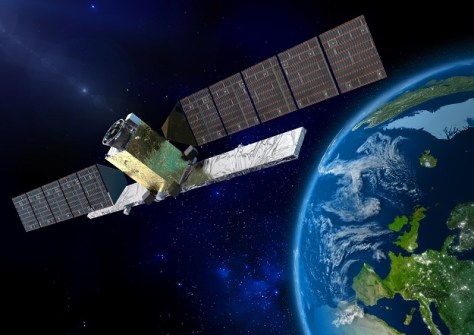
Thales Alenia Space has been awarded a contract to begin development of two Sentinel-1 Next Generation satellites.
The contract is just the beginning of an eventual $1.15 billion price tag for the final product.
The deal was awarded to prime contractor Thales Alenia Space — a joint venture of Thales (67%) and Leonardo (33%) — by the European Space Agency (ESA).
Sentinel-1 NG is part of Copernicus, the Earth Observation component of the European Union’s Space Program, which is managed by the European Commission and co-funded by the EU and the European Space Agency.
ESA is responsible for the development and launch of dedicated Sentinel satellites, as well as operating most of the missions and ensuring the availability of data (supported by the Italian Space Agency).
Airbus Defence and Space has been selected as the main industrial partner responsible for the Sentinel-1 NG’s C band synthetic aperture radar (SAR) instrument.
Environmental monitoring
According to Thales Alenia Space and ESA, the Sentinel-1 NG spacecraft will provide day-and-night observation data for (among other things):
- Environmental protection
- Climate monitoring
- Emergency management and security
- Maritime surveillance
- Monitoring of oceans, ice, and land (e.g. soil moisture, vegetation cover, forest types, and crop types and conditions)
- Natural disaster assessment
They’ll also tackle issues addressed by Copernicus’ Climate Change, Land and Marine Monitoring services.
“Sentinel-1 NG mission will serve as a new pillar aboard European Copernicus, the most sophisticated environmental monitoring program ever established, to which we are proud to contribute to 11 of the 12 missions,” said Thales Alenia Space CEO, Hervé Derrey.
New capabilities for the Sentinel-1 NG satellites
The Sentinel-1 NG satellites will be 3-axis-stabilised spacecraft based on a multi-mission platform already used for previous Copernicus missions, such as CHIME, CIMR, and ROSE-L.
The satellites’ C-band SAR will have a large, active, phased-array planar antenna measuring 13.6 m x 0.94 m and employing innovative multichannel acquisition capabilities enabled by new electronics developed by Thales Alenia Space.
According to the company, the technology will enable image resolution to be improved up to four times compared to the first generation, providing coverage of a larger observation area.
An improved quad-polarisation mode will provide better land monitoring abilities, and there will be a specific operating mode for sea ice observation.
“Thales Alenia Space will leverage its proven experience in radar Earth observation programs to contribute to this new challenging mission”, said Giampiero Di Paolo, Senior Vice President Observation, Exploration and Navigation.
“Sentinel-1 Next Generation will offer radar imaging capabilities far beyond those of Sentinel-1 first generation, thereby expanding coverage both in Europe and globally, while reducing the intervals between successive radar images”.