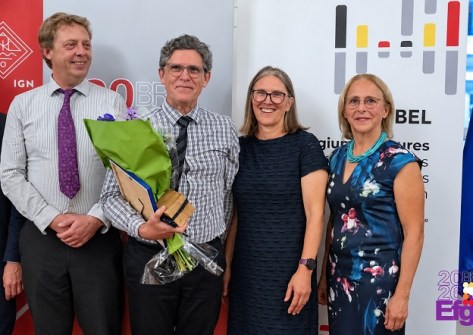
Australia’s Martin Brady has been awarded the prestigious international Lars H. Backer Prize for geospatial statistics.
The European and Global Forum for Geography and Statistics (EFGS) has awarded the Lars H. Backer Prize to Martin Brady, former Location Information Director with the Australian Bureau of Statistics.
This is the first time the Prize has been awarded to someone from beyond Europe.
The Prize recognises a person or organisation’s major contributions to the development of a geospatial foundation for official statistics, or for significantly improving the relevance of geospatial statistics for evidence-based decision making.
The EFGS cited Brady’s “outstanding and enduring contribution to the integration of statistical and geospatial information worldwide”.
“Over many years, Martin Brady has been a visionary leader, a tireless advocate, and one of the most influential champions of the global statistical-geospatial integration movement,” the EFGS prize committee noted.
“His personal commitment and sustained efforts have played a pivotal role in advancing the integration of statistics and geospatial information across continents, institutions, and professional communities.”
The committee went on to say that “Few individuals have embodied the spirit of ‘building bridges’ as consistently as Martin Brady. Through his enthusiasm, generosity, and commitment to collaboration, he has connected statistical and geospatial communities around the globe, creating partnerships and networks whose impact continues to shape the field today.”
Collaboration knows no borders
According to the EFGS, as a principal driving force behind the Global Statistical Geospatial Framework (GSGF), Brady “helped shape a concept that transformed the way statistical and geospatial information are brought together”.
“What in the beginning started as an ambitious vision evolved into a truly global framework whose influence can today be seen in national statistical and geospatial systems around the world and in the work of virtually all European statistical offices.”
“Even from ‘overseas,’ Martin Brady remained a devoted supporter and trusted friend of the EFGS community, making geographical distance irrelevant through his continuous engagement, encouragement, and willingness to help others. His enduring commitment demonstrated that collaboration knows no borders.”
As mentioned, the Prize was awarded to Brady largely for his work during the development of the GSGF, during which time he also served as co-chair of the relevant UN Expert Group, which Brady describes as being “a career highlight for me”.
In receiving the Prize, Brady acknowledged that the “work of many Australians sits behind the success of the GFGS. Notably, Ben Searle for the ideas behind Australia’s framework, which formed the basis of the global framework; early advocacy and support for the GSGF by Peter Harper, Gemma Van Halderen PSM and Alister Nairn; and the support and input from the team of ABS geospatial legends.”
“Many thanks also go to the UN secretariat, particularly Mark Iliffe and Greg Scott, to our co-chairs partners from Mexico — Rolando Ocampo and Paloma Merodio — and to all the members of the UN Expert Group on the Integration of Statistical and Geospatial Information (UN EG-ISGI), particularly those from Europe,” he said.
Brady also thanked his family “for accepting my absence overseas and in many late night international video calls”.
Related reading:
Geospatial’s role in government services