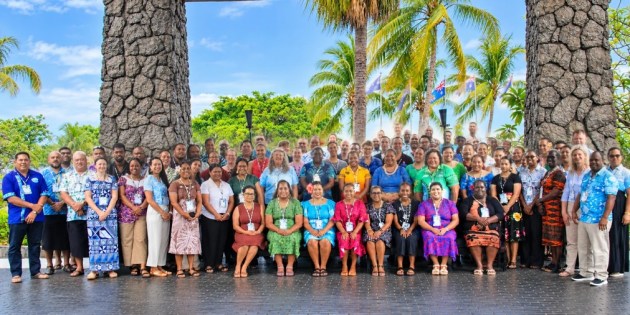
A Regional Marine Spatial Planning Learning and Knowledge Exchange Workshop in Nadi, Fiji, from 2 to 6 November 2026, brought together 14 Pacific nations.
The event marine spatial planning (MSP) event was the culmination of a co-design process initiated by the Pacific Community (SPC) and participating countries during the 2026 Pacific Islands Ocean Conference (PIOC).
A series of MSP deep-dive discussions at the conference gave countries an opportunity to reflect on their needs and priorities. Those discussions were followed by surveys, training needs assessments and mapping exercises that examined where countries currently are in their MSP journeys.
With the Pacific Ocean connecting diverse island nations across millions of square kilometres, the conversations about marine spatial planning revealed how many of their challenges, aspirations and questions are remarkably similar.
Opening the workshop, Jope Davetanivalu, Director of the Environmental Monitoring and Governance Programme at the Secretariat of the Pacific Regional Environment Programme, reminded participants why this work matters.
“It is no wonder we call the ocean our home,” he said, describing marine spatial planning as “our blueprint for the future”.
One of the recommendations that emerged from the consultations was for countries to have more opportunities to learn directly from each other.
As Tony Kabasi, SPC’s Team Leader for Ocean Management and Literacy, told participants, “This workshop places country experience at the centre of the conversation”.
Its success, he added, “will come from your willingness to learn and to share”.
Across the Pacific, countries are advancing MSP through a range of governance, policy, and institutional approaches. This work is supported by initiatives including the MSP for a Blue Pacific Economy, funded by the United States Department of State and the Climate and Biodiversity-Smart Marine Spatial Planning Programme, funded by the New Zealand Ministry of Foreign Affairs and Trade.
Different journeys, shared challenges
Participants emphasised that marine spatial planning is not a one-size-fits-all process.
Countries are advancing according to their own national priorities, governance arrangements, and development strategies, while drawing on regional support and shared experience.
For example, some activities commonly associated with MSP, such as marine protected areas (MPAs), may already be well established nationally and can form important building blocks within broader marine spatial planning efforts in some countries.
For others, fisheries management plans, coastal zoning initiatives, or marine conservation programmes have become foundations upon which broader MSP processes are being built. Yet despite these different starting points, many similarities emerged.
Country representatives repeatedly highlighted challenges with governance and coordination, limited technical capacity, data gaps, stakeholder engagement and sustaining political support over the long term.
During Fiji’s group presentation, Andrew Coriakula, Oceans Specialist at the Ministry for Environment and Climate Change, highlighted a key takeaway from the exercise: “We need to align technical capacity with political priorities and create a shared ocean interest at the community and decision-making level,” he said.
For Lukes Isechal, MSP Coordinator with the Ministry of Agriculture, Fisheries and Environment (MAFE) of Palau, understanding a country’s motivation for pursuing MSP is just as important as understanding the process itself.
“Pacific countries face many challenges on their MSP journeys, including institutional silos, limited technical and human capacity to engaging multiple sectors and stakeholders,” he said.
“It is important to prepare carefully and think long-term before embarking on what is often a complex and resource-intensive undertaking.”
Related reading:
Cook Islands adopts Geospatial Information Framework