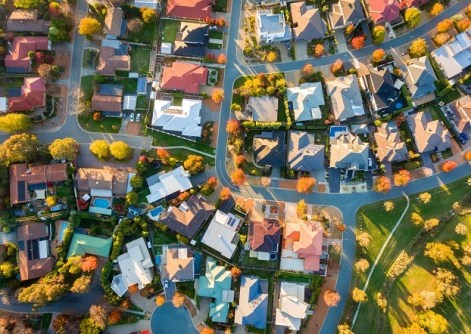
Research suggests most cities exceed the ‘critical speed limit’ of urban development for maintaining plant communities amid climate change.
From 1982 to now, a new study finds, cities that converted more than about 5.83 square kilometres of land to impervious surfaces each year tended to see the total productivity of their plant communities decline.
But in slower-developing cities, the ecosystem retained its ability to recover from land conversion, with climate conditions invigorating the remaining greenery enough for overall plant productivity to rise.
The offsetting effect doesn’t apply equally in every climate. But knowing when and where it kicks in could help planners adjust the pace of development to conserve city greenery in the context of climate change, the researchers hope.
“The speed of city growth matters. If cities expand too fast, they lose green land faster than plants can benefit from warming and higher carbon dioxide,” said Han Chen, an Earth system scientist at Tianjin University and lead author of the study.
“Slower and smarter growth can help cities keep stronger vegetation and better climate benefits.”
The drawback to fast city growth
Overall plant productivity in most cities drops as humans replace parks, lawns, farmland, wetland and patches of urban forest and grassland with buildings and pavement.
This cancels out any benefits the plant community as a whole might derive from warmer, more carbon-rich air due to climate change.
Chen’s team wanted to know whether a city’s development rate affects how easily that cancelling-out occurs.
“Previous studies mainly looked at one city or a few cities and often focused on the past,” Chen added.
“We wanted to study many cities around the world [and] include both past and future changes.”
Accounting for the elevated carbon dioxide levels found in most cities, the researchers used a vegetation model and satellite observations to simulate plant productivity from 1982 to 2100 in 2,126 cities around the world.
The researchers used a vegetation model and satellite observations
The cities were chosen to have more than 50 square kilometres of pavement and buildings to ensure the researchers were covering the bulk of the global urban environment.
The simulations considered various future scenarios of urban development and low, medium, and high greenhouse gas emissions.
What the urban development study found
Collectively, the cities in the study overshoot the team’s ‘speed limit,’ developing an average of more than 21 square kilometres within their boundaries each year and climbing.
North American and Asian cities build especially fast, averaging 26.6 and 35.8 square kilometres per year, respectively.
Of the cities studied, 1,713 showed declining plant productivity, with Shanghai, Chongqing and New Delhi emerging as notable hotspots.
But some cities fall below the threshold, mostly in Europe.
In Giffnock, Scotland, a moderate urban development rate has helped keep the plant community stable or rising and able to take advantage of any potential climate boosts.
Across the 413 cities where plant productivity rose from 1982 to the present, climate change accounted for approximately 69% of that trend.
Avoiding the tipping point
The researchers project the ‘tipping point’ may rise to 7.18 square kilometres per year as climate change progresses through this century, enabling cities to convert land slightly faster before incurring vegetation declines.
But those declines may be steeper, with the gap between greening and de-greening cities widening as urban development accumulates, too.
Represented in terms of the carbon plants lock into their tissues as they grow, the team estimates, average annual city plant declines from now through 2100 will rise roughly 1.5% to 2% from the 1982-2024 baseline, with plants losing around three grams of carbon per square metre per year.
“The number looks small, but cities cover very large areas, so the total loss can become large,” Chen said.
“It is like a slow leak: After many years it means less plant growth, less carbon uptake, and weaker cooling from urban green spaces. In practice, this can make cities hotter and less resilient.”
To maximise plant productivity, the researchers write, fast-growing cities should preserve green space as they grow, while slower-growing cities should focus on managing existing plant life to take full advantage of climate conditions.
The study — ‘The Pace of Urbanization Regulates Global Urban Gross Primary Productivity Trends’ — has been published in the Journal of Geophysical Research: Biogeosciences.