Welcome to Spatial Source’s International Women’s Day 2026 interview series.
We’re celebrating International Women’s Day 2026 by showcasing some of the outstanding individuals who are helping to shape Australia’s geospatial sector.
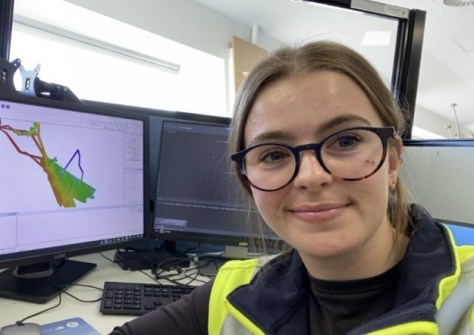
In this interview we speak with surveyor and spatial specialist, Phoebe Davis. Although still young, she has packed an enormous variety of experiences into her career so far, including recently returning from a year spent at Leica Geosystems’ headquarters in Switzerland.
How did you get into this field and what attracted you to it?
I studied a Bachelor of Surveying and Spatial Science (now known as a Bachelor of Geospatial Science with a Major in Surveying) at the University of Tasmania. I got into this by having an interest in technical fields such as architecture and engineering but loving the idea of working outdoors in remote locations more than spending time building CAD models.
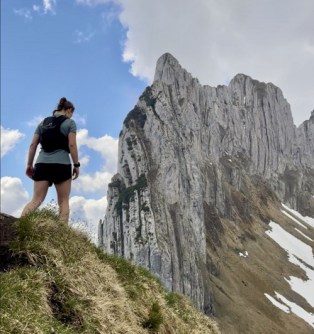
I grew up spending a lot of time outdoors, bushwalking, orienteering, fishing, cycling, rowing, running etc. During my years of orienteering, I became interested in the way the land is mapped, how you can look at the piece of paper in your hands and then look up and see it in real life.
I also enjoyed maths (when I understood it) and the challenge of problem solving.
What do you enjoy most about your job/studies?
Being able to work outdoors in a new site every day or at least week. I enjoy that I get to see some pretty remote locations that the public are not generally allowed access to. I also enjoy the indoor tasks of surveying, such as drafting plans and maps in the time between field days.
I like that I have taken this job off-shore into the ocean and overseas, and I love how I am offsetting the bias of the male-female ratio.
I enjoy the diversity of the work — from flying drones over powerlines through paddocks, digging through a metre of soil in the suburbs to find a rotten wooden dumpy peg, shooting bearings through coffee shop windows in the CBD, to mapping the seafloor in 4,000m of ocean.
The opportunity to work for Leica Geosystems in Switzerland put me in touch with people from all across the world. In fact, in my team of 12 people, there were 12 different countries represented.
Are there any personal qualities or attributes that are helpful to have in this field?
You must be pretty open to long days in the field, working in the rain and cold and mud and wind. Or working in 32-degree weather with long pants and shirt and steel caps, a long way from the car, food and water. Also, working in sometimes chest-level (for me, not that tall) grass, potential for snakes etc.
You must be resilient and understand that mistakes are normal initially. Also, being open to constructive feedback is important (especially when drafting survey plans).
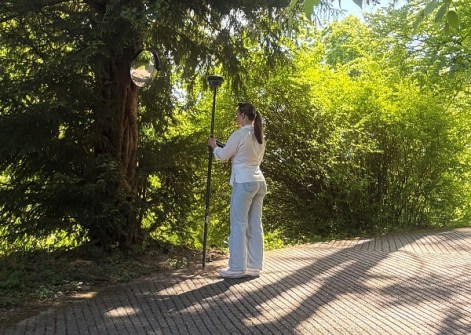
You must be open to diversity of work. One day you are bush-bashing through the Tasmanian wilderness carrying tripods, a total station, prisms, a metal detector, corner pegs, star pickets, spades, a pickaxe, and a sledgehammer. The next you are on a 30-hour journey to the other side of the world to learn and work in a role you have barely any knowledge in, not to mention trying to fit in to a community of engineers who speak multiple languages.
What makes you proud about your role and achievements?
Being the only female to graduate from my degree course (albeit only four of us graduated that year). Therein lies another point, though: being part of such a small cohort is pretty cool. It is much more specialised than many other degrees, which makes me feel proud.
It makes me proud that I got through my first year of university maths. Many of my peers, most of them engineers, had studied specialised maths the year prior and were privy to a large amount of the content. I had not taken specialised maths during school and struggled to keep up with the pace of content being taught at uni, not to mention the actual mathematical material. I ended up with five different tutors and spent an incredible amount of time studying, writing and re-writing notes, practising questions, reading textbooks, all to come out of that year with a distinction.
It makes me proud that I have had many experiences in different geospatial sectors already and I only graduated a bit over one year ago. I worked for a year with hydrographic surveyors at CSIRO during my second year of university. I worked with a local land surveying business for one year in my third and final year of university. And in 2025, I worked with Leica Geosystems AG in Switzerland for one year after getting my six-month contract extended.
As a woman, have you had any struggles during your career? Conversely, have you had support?
I went to an all-girls school between the ages of 13 and 18. I know there is debate about single sex versus co-ed schools, but this school helped me a great deal in getting onto the path I am now on. There was a heavy focus on women in STEM and students undertaking non-stereotypical roles. Even during their senior years, students could pursue their individual interests as part of their curricular studies. Students were studying architectural subjects, woodworking, cooking, sewing, physics, university mathematics, outdoor leadership… the list goes on.
In addition, for an entire year, there was a focus on outdoor education such as bushwalking, camping, caving, canyoning, rock-climbing, white-water rafting etc. Whilst I may have had some trials and tribulations, and it was definitely not all plain sailing, I had some fantastic teachers, supporters, mentors, friends, challenges and experiences.
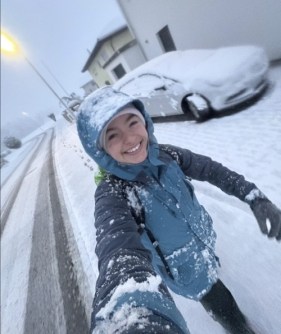
During my university career, I had the most wonderful degree coordinator and lecturer. Not only is she one of the most kind and intelligent women I have ever met, she generously devoted countless hours to working through my million questions about the concepts we were learning, helped me solve my giant survey misclosure issues, drew diagrams to help me figure out worded questions, and clarified mysterious surveying jargon. She also played a huge part in supporting me to obtain my visa to go to Switzerland. She really is the best woman in STEM I have ever met.
We need more women in the geospatial sector. Do you have any ideas?
In general, we need more people in the geospatial sector. More scholarships, taster programs, and positive media might make it more enticing. One year prior to starting my university degree, I had never heard about surveying or geospatial science in general. I went to several career events and only saw architecture or engineering. To the younger generations of women wondering what to study, geospatial science should be an obvious competitor next to engineering and architecture.
I would like to see jobs that women are excelling in (especially those in male-dominated fields) being discussed throughout the year, not just for International Women’s Day. I also think that younger people don’t appreciate the range of different specialities within the field of geospatial science. They could be creating bushfire analysis plans from satellite imagery, mapping sea ice changes down in Antarctica, or working abroad helping in product management of GNSS or land surveying technologies. The world really is every young person’s oyster when it comes to geospatial science because it is the backbone of everything!
A wise woman (who also happened to be my lecturer at university) once said that without geospatial science, the economy would be dysfunctional, self-driving cars would be crashing, bushwalkers would be getting lost, and ships would be running ashore (and this is just the start).
What would you say to women who are considering a career in geospatial?
Just do it. I have had absolutely zero regrets. I have met some of the coolest friends from all over the world, I have learned so much, been to so many amazing places, and I feel like there is so much more to keep on learning. In addition, you can sign up to this degree and be fairly certain that you will have work at the end of your university studies.
Also, you get to look pretty cool driving a huge truck wearing high-vis when the guys pull up beside you at the traffic lights.