Welcome to Spatial Source’s International Women’s Day 2026 interview series.
We’re celebrating International Women’s Day 2026 by showcasing some of the outstanding individuals who are helping to shape Australia’s geospatial sector.
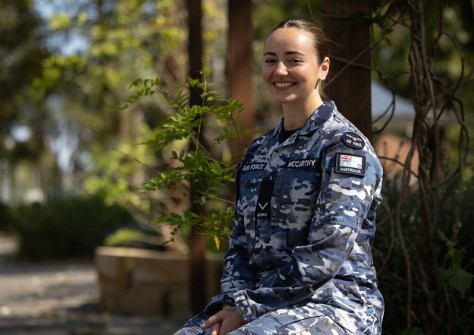
In this interview we speak with Leading Aircraftwoman Charlie-Elle McCarthy, a Geospatial Intelligence Analyst in the Royal Australian Air Force.
How did you get into this field and what attracted you to it?
In high school I had a really great geography teacher who told me I had potential for a geography or geospatial career, and this always stuck with me. I really enjoyed geography and all the different topics we covered and just how broad it can be.
I had a friend at the time who was considering a job in the Royal Australian Air Force, and who told me to have a look at the jobs available. I saw Geospatial Intelligence Analyst listed and remember getting very excited about the possibilities and what a job in this field could really mean for me.
I enlisted into the role of Geospatial Intelligence Analyst, and it was around 12 months of training until I was fully qualified plus a little more to be completed at my first unit when I got there. I thoroughly enjoyed all the courses because you’re continually learning and adapting to new challenges thrown at you and your team. Being in the military is always a team environment and something I really enjoy.
Please tell us about your current role and responsibilities.
I currently work in the team that plans for a number of Air Force and joint ADF exercises. I work in product creation where I produce visual aids in the form of virtual and printed maps, intelligence support, imagery analysis and imagery-based reports that contribute to these exercises.
What do you enjoy most about your job/studies?
I enjoy that I contribute directly to the intelligence capability and Air Force’s exercise planning. I enjoy making sense of difficult-to-understand concepts by being able to represent them visually onto maps, providing detail and meaning to exercise planning, and the future development of Air Force intelligence capability.
I love that every day is a different day, working on a different skill set, working with different data and working with different units and personnel to create visual representations of problem sets.
There are many pathways for Air Force intelligence personnel: working within the operational and strategic environments; working in weaponeering and targeting, cyber and space; or with specialised units in remote sensing and satellite imagery. I like that there are so many options for us to be able to either stay within a particular field or continue learning new things every two to three years when we post to a different unit or location.
Are there any personal qualities that are helpful to have in this field?
I would say flexibility would definitely be a great quality to have since the nature of our job means we often move houses, states, and sometimes even countries every couple of years. We often go away for weeks at a time for exercises and courses that directly affect our career progression and rank promotion.
Being a little quirky is always a good thing in our trade; it creates a more diverse office space and can make for some interesting debates!
What makes you most proud about your role and achievements?
I have had so many career highlights in my short career so far!
I have been involved in many, very important military parades and ceremonies, including the Royal Australian Air Force’s Centenary Queen’s Colour Parade held at Government House in Canberra.
In a previous role, I worked in Canberra where I worked with target coordinate mensuration, which essentially means measuring intensely accurate coordinates for weapons effects. While in this role, I was on an Air Force exercise planning for the real-life testing of weapons effects using some new weaponry that was being introduced into the ADF at the time. The coordinates my team produced proved to be extremely accurate and correctly impacted the desired target. This has, so far, been the highlight in my career.
Along with some of my previous peers, I also co-founded the Junior Aviator Group (JAG) in Air Force. JAG is a networking group designed to support, mentor and empower our junior workforce in Air Force. It’s about giving them the confidence and space for growth in their careers to become aviators who strive for excellence and excel in their careers while also meeting like-minded individuals. We organise professional development presentations, opportunities for social activities, access to networking within the junior workforce, specific career progression information and links to relevant courses.
Have you had any struggles during your career? Conversely, have you had support?
I honestly have not had any struggles being a woman in Defence. I guess I joined at a great time because we have many women in my trade in geospatial intelligence, and I think all our units and locations are very welcoming and inclusive for women.
In Air Force we have the WINGs initiative, which is the Women’s Integrated Networking Group. That’s where we share information, network with women in other jobs in Defence, attend talks from important women in Defence and become involved in social activities. This helped me in my junior years, before we had the JAG, by giving me opportunities to meet women my age with similar interests when I was posted to a new location. It also gave me a space where I could ask for help with navigating Defence life.
We need more women in the geospatial sector. Do you have any ideas?
I would tell women in universities about the opportunities within the geospatial sector and all the jobs available. I know the ADF advertises military careers at university open days, so having Q&As with serving members in Geospatial Intelligence within Defence could increase numbers.
What would you say to women who are considering a career in geospatial?
If you are a woman who enjoys geography, statistics, problem-solving or mathematics, I would say absolutely go for it! It is a fantastic career choice with so many awesome opportunities.