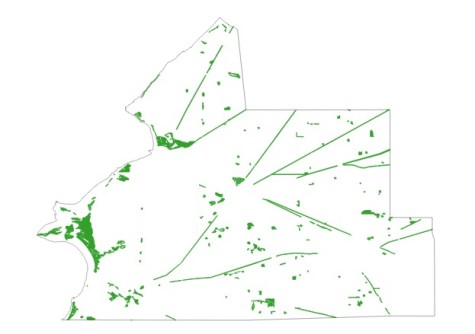
Historical vegetation maps have been used to picture what a re-vegetated Australia might look like.
Australia is signatory to an internationally agreed goal of returning 30% of land to nature, but that’s the bare minimum we should be aiming for, according to an Adelaide University study.
Environmental Science Masters graduate Peter Martin argues that Australia may need to fundamentally redraw its rural landscape — retiring farms, restoring vast tracts of vegetation and reshaping regional economies — if it is to avoid accelerating species loss and meet global biodiversity targets.
The 30% target was endorsed globally in Montreal in 2022, including by Australia, but translating it into reality — particularly in heavily cleared agricultural regions — could prove difficult, Martin says.
His project, completed in 2025, examined four South Australian local government areas — the Coorong, Yorke Peninsula, Grant and the Copper Coast — all of which fall well short of the 30% benchmark.
In some areas, native vegetation has been reduced to just a fraction of its original extent. The Copper Coast, for example, retains only 3.6%.
What a restored landscape might look like
Using historical vegetation maps prepared by the SA Herbarium, Martin’s project outlined what a 30% restored landscape could look like. Along South Australia’s Copper Coast, for example, a future scenario shows native mallee, woodland and shrubland returned to 30% of the region.
The approach avoided complex modelling, instead relying on well-established knowledge of where different vegetation types once thrived. The presence of roads, towns and other key infrastructure was considered, alongside the need to minimise fire risk.
To reach the target, large areas would need to be restored — not just marginal land, but in some cases even productive farmland. In the long term, some properties would need to be taken out of agriculture and returned to native ecosystems.
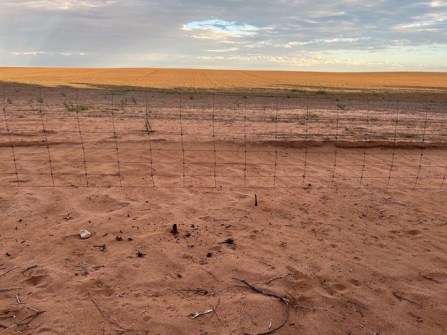
“This is not tinkering at the edges,” Martin said. “It implies major land use change at a district scale.”
The long-term vision is a new farming landscape with a mosaic of restored ecosystems that are highly valued by local communities.
“Instead of communities seeing their district as a ‘wheat-sheep zone’, they’d see and value it as a ‘wheat-sheep-mallee ecosystem’ zone, suggests Martin.
“The region might generate slightly less agricultural produce, but social and health science suggests that a more natural and diverse landscape can significantly improve human health and mental wellbeing.”
Human-driven mass extinction
The biggest barrier is not technical feasibility, but ‘social licence,’ according to Martin.
“Community acceptance of sweeping, long-term change is slow and difficult,” he said.
“Farming regions built over generations of clearing and production are unlikely to embrace rapid and large-scale ecosystem restoration, particularly if it threatens livelihoods.”
A transition guided by such a blueprint would need to unfold over decades, possibly even a century, he said.
“It is possible but would need to be backed by sustained government and community support,” he added.
“Climate change adds further urgency and complexity. As temperatures rise and rainfall patterns shift, areas currently suitable for cropping may become marginal or unviable.
“In South Australia’s Mid North, for example, the historic boundary for reliable agriculture known as Goyder’s Line is already moving south.
“By the end of the century, climate projections suggest that Kadina, a major grain-producing centre, could resemble the far drier conditions of Hawker in the Flinders Ranges today.”
Martin’s warning comes amid growing global concerns that the planet is already deep into a human-driven mass extinction event.
According to the Grantham Research Institute on Climate Change and the Environment, species are disappearing at 10 to 1000 times faster than the natural rate of extinction, with at least 1.2 million plant and animal species under threat of extinction.