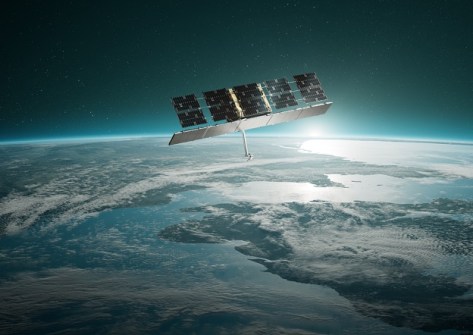
The recent SpaceX Transporter-15 rideshare launch on 28 November, carried into orbit two batches of Earth observation satellites for Greece and Italy.
The two ICEYE high-resolution synthetic aperture radar satellites for Greece were funded through the EU Recovery and Resilience Facility, in collaboration with the Greek government, the private satellite company ICEYE and the European Space Agency.
The spacecraft are the first of 13 Earth observation satellites planned under the Greek National Small Satellite Program, grouped into four categories based on their instrument types.
The aim of the program is to boost Greece’s capacity for disaster management, environmental monitoring and national security.
The two radar satellites, each of which have a mass of about 120 kg, are able to provide high-resolution (up to 25 cm) X-band data in several observation modes, at all times of the day and night.
The partnership with ICEYE will see the private company operate the satellites while also providing Greece with access to the firm’s other satellites.
The other 11 satellites in the constellation are due for launch in 2026.
They will include four thermal-infrared satellites developed by OroraTech, designed to detect heat signatures and monitor wildfires and thermal activity, and seven high-resolution optical satellites developed by Open Cosmos, which will provide detailed imagery to support environmental monitoring, agriculture and urban planning.
IRIDE for Italy
Development of the eight IRIDE Eaglet II Earth observation satellites launched for Italy has been coordinated by ESA with support from the Italian Space Agency. The program is funded by Italy’s National Recovery and Resilience Plan.
The IRIDE mission will comprise Earth observation constellations that will deliver satellite data for Italy’s public authorities to support the monitoring of ground motion, land cover, water resources, coastal zones and other environmental factors.
The Eaglet II satellites will orbit at an altitude between 467 km and 625 km and provide multi-spectral images with ground resolution of about 2 m.
The mission life for the Eaglet II constellation is about three years and, when complete, it will consist of 24 satellites. Each satellite is the size of a microwave oven and weighs about 25 kg.
Eaglet II is the second of six constellations for IRIDE. The first, Hawk for Earth Observation (HEO) was launched earlier this year.
A further four constellations will be launched as part of the IRIDE programme with a total of 68 satellites under development.
The other IRIDE satellites will be launched in a staggered manner, achieving full deployment by 2027.