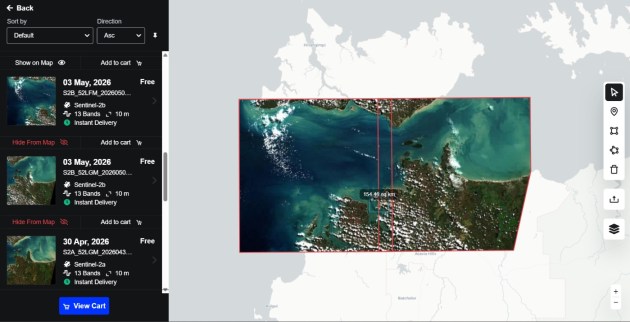
Spiral Blue has chosen Arlula’s Sales Engine platform to distribute data from the former’s upcoming Teal LiDAR satellites.
According to Arlula, the selection of Sales Engine will provide Spiral Blue with an end-to-end sovereign ground segment layer, enabling customers to securely discover and access decision-grade LiDAR data and task the constellation through a single trusted interface.
“Spiral Blue is exactly the kind of operator Sales Engine was built for,” said Sebastian Chaoui CEO Arlula.
“Their LiDAR products can reach customers from day one of operations, without their engineers being pulled into building bespoke commerce infrastructure.”
Spiral Blue’s Teal constellation is being designed to deliver highly accurate LiDAR Earth observation data with near real-time revisit capability as the constellation scales.
The company is aiming to achieve 1m horizontal accuracy and 10cm vertical accuracy with its Teal satellites, and to provide near-real time revisit rates as the constellation expands.
And it has its eye on a growing range of defence and intelligence applications such as terrain intelligence, infrastructure monitoring, maritime surveillance, targeting support, and battle-space awareness.
Sovereign ambitions
Spiral Blue is one of a small number of innovative Australian space technology companies making waves in orbit. It has already deployed ten NVIDIA-powered edge computing systems in satellites across customer and partner missions.
In March this year, the company exported Australia’s first defence-focused space LiDAR capability to a UK partner.
“Building advanced LiDAR satellites is challenging enough without also building the infrastructure to distribute the data,” said Taofiq Huq, CEO of Spiral Blue.
“Sales Engine gives our customers a trusted sovereign platform to access Spiral Blue data while our team stays focused on deploying our Teal constellation and delivering high-quality insights for defence, government, and commercial users.”
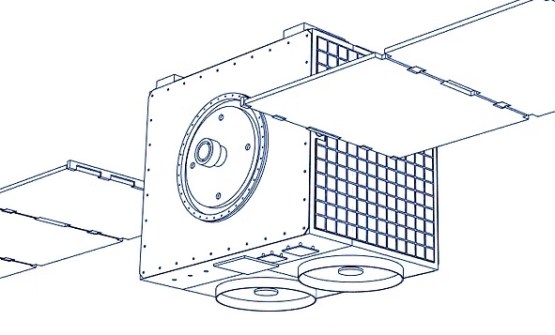
In September last year, the company was awarded a $3 million Cooperative Research Centres Projects (CRC‑P) grant to develop what it says will be the world’s first AI-enabled LiDAR satellite.
The company is also planning to launch a fixed-wing drone LiDAR program over New South Wales.
Arlula itself is no stranger to significant funding injections, having won the Croc Pitch 2025 competition in March this year, bringing with it a prize of up to $1 million.
It also successfully completed a $3.4 million capital raise that same month, boosting its ambition to automate the process of acquiring Earth observation data.