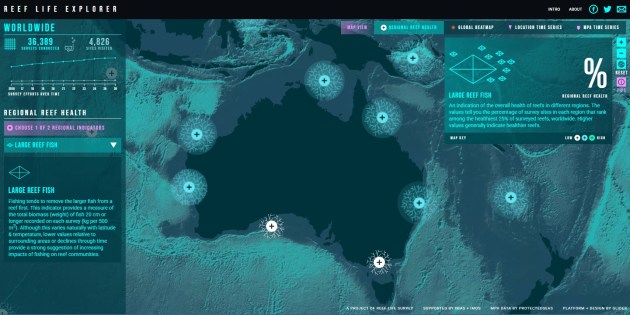
The upgraded Reef Life Explorer platform now features a time series layer that displays long-term ecological data collected from reefs.
The graphical representation of the health of reefs within marine protected areas (MPAs) enables users to explore decades of ecological change across protected reefs in Australia and worldwide.
The interactive tool was developed by researchers from the University of Tasmania’s Institute for Marine and Antarctic Studies (IMAS), working with Parks Australia and Reef Life Survey.
For the first time, users can use the platform to directly compare ecological trends inside and outside protected areas using a standardised approach, revealing how reef ecosystems respond to protection over time.
Many nations, including Australia, have committed to protecting 30% of the world’s oceans by 2030 under the Global Biodiversity Framework.
“Shallow reefs worldwide are under increasing pressure from fishing, ocean warming, harmful algal blooms and other human impacts,” said IMAS researcher, Ella Clausius, who led the project upgrade.
“Marine protected areas are one of our most important tools for conserving marine life, but we can’t manage what we can’t measure,” added Clausius.
“Long-term monitoring is essential for understanding how ecosystems are changing underwater and identifying which management approaches are delivering the greatest benefits for biodiversity, allowing us to continually improve the effectiveness of marine conservation over time.”
Reef views at regional, national and global scales
The upgraded Reef Life Explorer platform allows users to examine ecological trends across the Australian Marine Parks network and compare them with state-managed and international protected areas.
The new MPA Time Series Layer displays data collected from reefs from as far back as the 1990s in some cases.
Users can explore changes in reef condition at multiple scales, from individual protected areas through to regional, national and global trends.
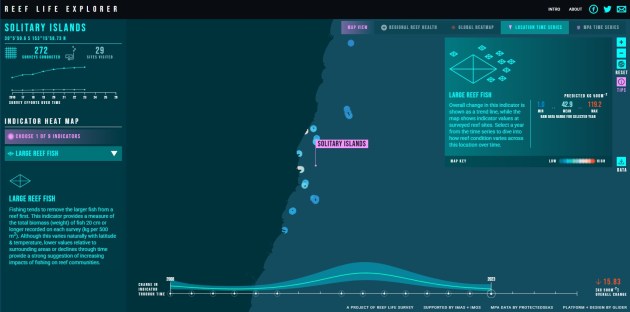
The platform draws on more than 36,000 underwater surveys conducted across 4,800 shallow reef sites worldwide, representing one of the most comprehensive standardised datasets ever assembled for shallow reefs.
“The Reef Life Explorer tool gives us a national view of ecological changes occurring across our marine parks, allowing our marine park managers to identify trends and respond more quickly to emerging issues,” said Parks Australia Branch Head, Marine and Island Parks, Shaun Barclay.
“For the first time, we can see in one-place long-term ecological trends across reefs spanning whole networks and see where ecosystems are improving or where they may need additional management attention.”