Adelaide University researchers have successfully tested a new type of portable atomic clock at sea for the first time.
The technology could one day help power the next generation of navigation, communications and scientific systems.
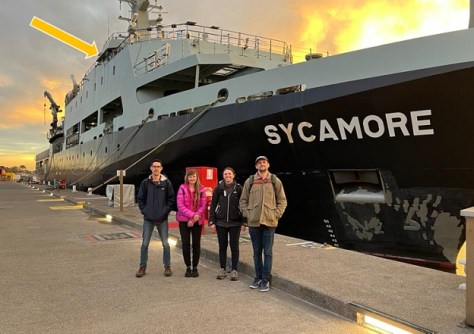
The research team, from the Institute for Photonics and Advanced Sensing (IPAS), developed the highly precise device and trialled it aboard the Royal Australian Navy’s training ship ADV Sycamore in July 2024.
Cool clocks
Most high-performance atomic clocks are not easily transported and are designed to operate only in carefully controlled laboratory environments, not in challenging real-world conditions.
But the new IPAS-developed device is different.
The researchers developed a portable optical atomic clock that uses laser-cooled atoms of the element ytterbium to keep time with extreme precision.
By cooling the atoms with lasers and measuring a very specific atomic transition, the clock can track time far more accurately than conventional systems.
The device was transported from the laboratory and installed on a naval vessel, where it operated continuously for several days while the ship was at sea. Despite the motion and environmental changes typical of a maritime environment, the clock maintained the same high level of performance observed during laboratory testing.
To the team’s knowledge, this is the first time a laser-cooled optical atomic clock has been demonstrated at sea.
Robust technology
Professor André Luiten, IPAS Chief Innovator and lead researcher on the project, said the goal was to take laboratory technology and make it usable in the field.
“Atomic clocks underpin many of the technologies we rely on every day, from satellite navigation to global communications,” Professor Luiten said.
“Until now, the most precise clocks have largely been confined to specialised labs. Our work shows that this kind of performance can be achieved in a portable system that operates outside the laboratory.”
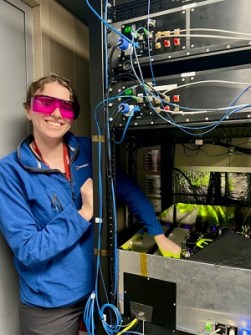
Professor Luiten said that testing the clock on a ship was a major milestone.
“The marine environment presents vibration, movement and temperature changes that are very different from a controlled laboratory,” he said.
“Successfully running the clock in those conditions shows that the technology is robust and ready to move closer to real-world applications.”
Multiple uses
Portable atomic clocks are attracting increasing global interest because of their wide range of potential uses.
In navigation, they could support future positioning systems that work when GNSS signals are unavailable or disrupted.
In telecommunications, they could improve the synchronisation of large networks.
They could even be used in fields such as radio astronomy, where extremely accurate timing helps link observations from telescopes around the world.
Teamwork
Professor Luiten said the project highlights the importance of collaboration between universities and government agencies in advancing critical technologies.
“Developing practical quantum technologies such as portable atomic clocks requires a combination of fundamental science, engineering and real-world testing,” he said.
“This trial shows that Australia has the expertise to build world-leading precision timing technologies that could benefit both scientific research and future industries.”
The team is now working to further refine the technology and explore additional field deployments, with the aim of making portable ultra-precise clocks available for a range of scientific, commercial and defence applications in the years ahead.
The research was supported by the Defence Science and Technology Group and funded through the Australian Government’s Next Generation Technology Fund, which is now managed by the Advanced Strategic Capabilities Accelerator.
The results of the test campaign have been published in the journal Optica.
See also:
Testing GNSS alternatives for military forces