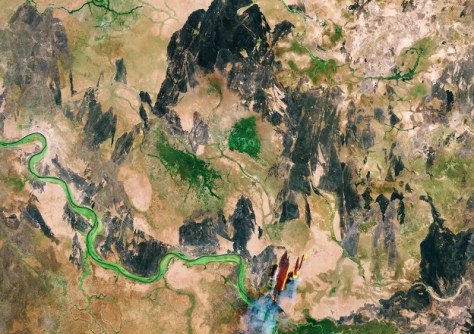
Research out of the US suggests that global satellite image-derived forest coverage measurements could be out by up to a factor of 10.
The researchers compared eight leading forest datasets and found that they concurred in identifying forest locations only 26% of the time.
According to one of the study’s co-authors, Daniel C. Miller of the University of Notre Dame’s Keough School of Global Affairs, the difficulty arises from the different ways in which researchers define what constitutes ‘forest,’ as well as the differing technology they use.
“When land is viewed from the sky, it’s difficult to know at a global scale whether something is a forest or not,” he said.
“Some might consider a small patch of trees to be a forest, but for others only a large, dense area of trees will count.”
The uncertainties generated from discrepancies among datasets can sometimes reach as high as a factor of 10.
The researchers give the example of savanna regions that include a portion of forest. Some coverage maps might identify such areas based on as little as 10% tree canopy coverage while others specify 50%.
Using case studies from India, Brazil and Kenya, the authors show the effect that such discrepancies can have.
For example, in India, the estimated number of people who live in poverty near forest ranges from 23 million to 252 million depending on which map is used.
Miller says policymakers and researchers should instead use hybrid data that combines in situ views with satellite data.
“By bridging the gap between satellite technology and on-the-ground reality, we can provide more accurate, inclusive data that truly supports both the planet and the people who protect it,” he said.
One area of endeavour that can be affected is the estimation of carbon sequestration potential within forests. Another is the timber industry.
Study lead Sarah Castle from the University of Wisconsin–Madison, points out the need for trusted data, standardisation and transparency.
“If we cannot establish a reliable baseline for forest area, it undermines trust in nature-based markets and makes it nearly impossible to accurately measure the role forests play in supporting people’s lives and livelihoods,” Castle said.