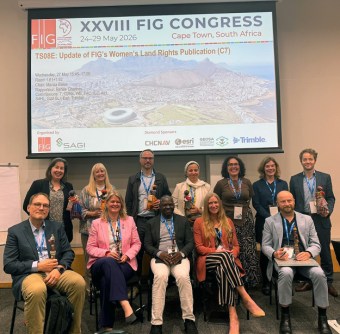
A landmark new report on advancing women’s land rights outlines 10 steps for global action by professionals in the land administration sector.
The report, ‘Advancing Women’s Land Rights: A Call to Action through Ten Commitments for Surveyors and Other Land Professionals,’ has been published by the International Federation of Surveyors (FIG).
Diane Dumashie, FIG President, said that advancing women’s land rights is essential to building more equitable, inclusive and sustainable societies.
“Beyond a productive asset, land is a source of identity, security, and opportunity,” she said.
“Yet, despite progress in legal and policy frameworks, women worldwide continue to face barriers to accessing, using, and controlling land, rooted in legal, institutional, and socio-cultural constraints.
The 10 steps for women’s land rights
The 10 steps outline by the report are grouped into four key intervention areas, as follows:
Key intervention area 1: Supporting legal recognition and reform
- Commitment 1: Recognise women as legitimate land rights holders
- Commitment 2: Address legal pluralism with care and responsibility
- Commitment 3: Do no harm in land formalisation and development
Key intervention area 2: Strengthening institutions and professional practice
- Commitment 4: Make land procedures accessible and gender-responsive
- Commitment 5: Uphold ethical conduct and professional accountability
- Commitment 6: Ensure women’s rights are visible in land information systems
Key intervention area 3: Transforming social norms through inclusive practice
- Commitment 7: Design and implement gender-responsive and inclusive land administration processes
- Commitment 8: Support women’s participation and leadership in land governance
Key intervention area 4: Leveraging finance, data and technology
- Commitment 9: Strengthen links between land rights and women’s economic empowerment
- Commitment 10: Use technology responsibly and inclusively
Local support, international action
Surveyors Australia has welcomed the release of the publication, saying in a statement that “The publication highlights the important role surveyors and land professionals play in land administration systems, including how land rights are recognised, recorded, and supported in practice”.
“We encourage members interested in land administration, cadastral systems, spatial governance, and international practice to read the publication and engage with the broader global discussion taking place through FIG.”
Kate Fairlie, co-author of the publication and a Land Administration Specialist with Land Equity International in Wollongong, said that “Even in Australia, where we have one of the world-leading cadastral systems, we lack nationally reported data on the extent of women’s land ownership”.
“And we know that women are disproportionately affected in financial climates like we have now – with rising living costs and housing affordability pressures,” she added.
“Australian surveyors have a role to play in the Pacific — but there are also concrete actions we can do closer to home”.