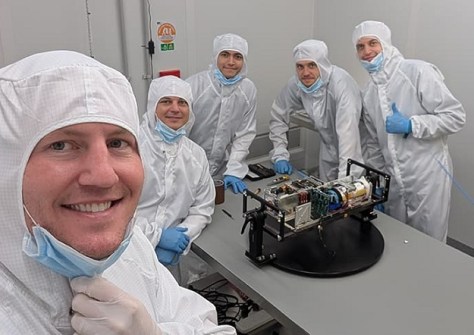
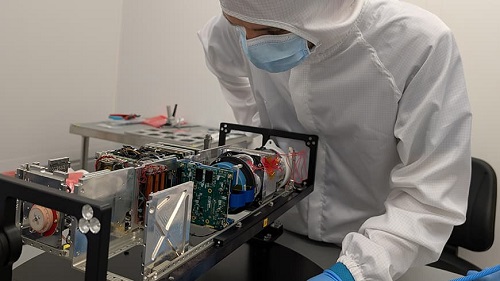
The SWIRSAT infrared satellite is taking shape at Edith Cowan University ahead of its upcoming launch.
SWIRSAT will be a short-wave infrared Earth observation satellite functioning in low Earth orbit — 500 kilometres altitude at an inclination of 45 degrees.
With a swath width of 14 kilometres, it will image in 4 short-wave infrared bands with 4 metre resolution, and 8 visible and near-infrared bands with 1.5 metre resolution.
The satellite is being built in Australia by LatConnect 60 (LC60) — the company received grant funding from the Australian Space Agency and the Government of Western Australia — but it will be launched from India in December this year. A second satellite is set for launch in the first quarter of 2017.
According to LC60, the SWIRSAT mission “aims to significantly lower the cost of data acquisition and insight generation of key indicators like methane and carbon dioxide — supporting our agriculture and resources sectors to achieve emissions reduction and NetZero targets”.
“Operating in the 1000–1750 nm spectrum, SWIR cuts through atmospheric obscuration and interacts with material composition and moisture content rather than light reflection alone.”
But clearly the company also has its sights set on the increasingly important — and competitive — intelligence, surveillance and reconnaissance (ISR) market.
According to LC60, SWIRSAT will be ideal for:
- Maritime domain awareness: Piercing mist, aerosols and coastal humidity to capture enhanced vessel wake signatures and movement patterns.
- Infrastructure monitoring: Detecting subtle alterations in soil compaction, moisture variance, and surface material states to uncover concealed supply routes, site preparation and camouflage.
- Missile infrastructure and post-strike assessment: Seeing through smoke and post-event debris to enable battle damage assessment.
Satellite students set their sights on orbit
One of the SWIRSAT satellites is currently taking shape at a new ISO 6 (Class 1000) cleanroom facility at Edith Cowan University’s (ECU) Joondalup campus in Perth’s northern suburbs.
The cleanroom was made possible through $3.5 million in state government funding.
ECU’s Deputy Vice-Chancellor Research, Professor Paulo de Souza, said that the facility “enables local assembly, integration and testing of satellites, all capabilities that are key to moving WA up the global space value chain”.
It’s also giving ECU students hands-on experience with designing and building Earth observation satellite technology.
“Few universities globally can claim to be building satellites in partnership with industry at this level, let alone giving students a front-row seat,” said de Souza.
Two of those students are Andrew Burton and Yash Fatania, who have spent the last 12 months working on the project.
The duo recently spent a period working with LC60’s international experts and engineers from NanoAvionics, a Lithuanian small satellite integrator.
“Two engineers flew out from Lithuania, and we were working alongside them right here on campus. It’s the first time that’s ever happened here,” said Fatania.
“We assembled the payload and integrated it — it was a very intense nine days.”
Both students are due to fly to Lithuania for six weeks to contribute to critical testing phases such as vibration testing, thermal vacuum chamber trials and optical verification.
“To have our students helping build a satellite that will soon launch into space is extraordinary, but what excites me most is what they’re learning through that experience and the opportunities it creates for their future careers,” said ECU’s Vice-Chancellor, Professor Clare Pollock.