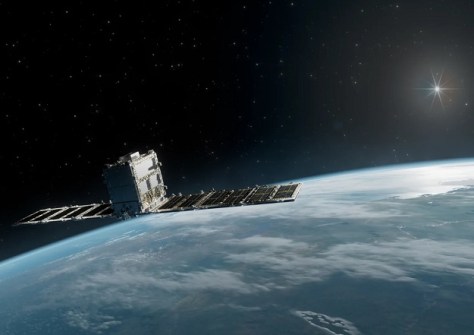
The eighth satellite for synthetic aperture radar firm, Synspective, has reached orbit.
Launched aboard a Rocket Lab Electron launch vehicle on March 20 from the Mahia spaceport in New Zealand, the StriX spacecraft joins seven of its siblings.
Synspective, a Japan-based company, has plans for a 30-satellite StriX constellation to be operational by the end of the current decade.
The satellite draws its name from the Latin name for the Ural Owl, Strix Uralensis, with the capital X representing the spacecraft’s X-band operational wavelengths.
Low-mass, low-cost
This latest StriX satellite has been placed into a 573-kilometre-altitude sun-synchronous orbit, where it and its companions will contribute data for disaster response, Japanese national defence and environmental monitoring.
The synthetic aperture radar (SAR) satellite was jointly developed by Synspective, the University of Tokyo, the Tokyo Institute of Technology, and the Japan Aerospace Exploration Agency (JAXA).
The technology used came from a Japanese government-led R&D initiative known as the Impulsing Paradigm Change through Disruptive Technologies (ImPACT) program.
According to Synspective, StriX’s foldable SAR antenna, increased power and advanced thermal control has resulted in a reduced satellite size while retaining imaging capabilities that compare favourably with large SAR satellites.
The company says the 100kg-class satellite has a mass around 1/10th that of conventional large SAR satellites, and that the use of commercial off-the-shelf (COTS) components and miniaturisation has kept the cost down to about 1/20th that of larger satellites.
Multiple modes
Each StriX satellite emits at 9.65GHz and has three modes of operation.
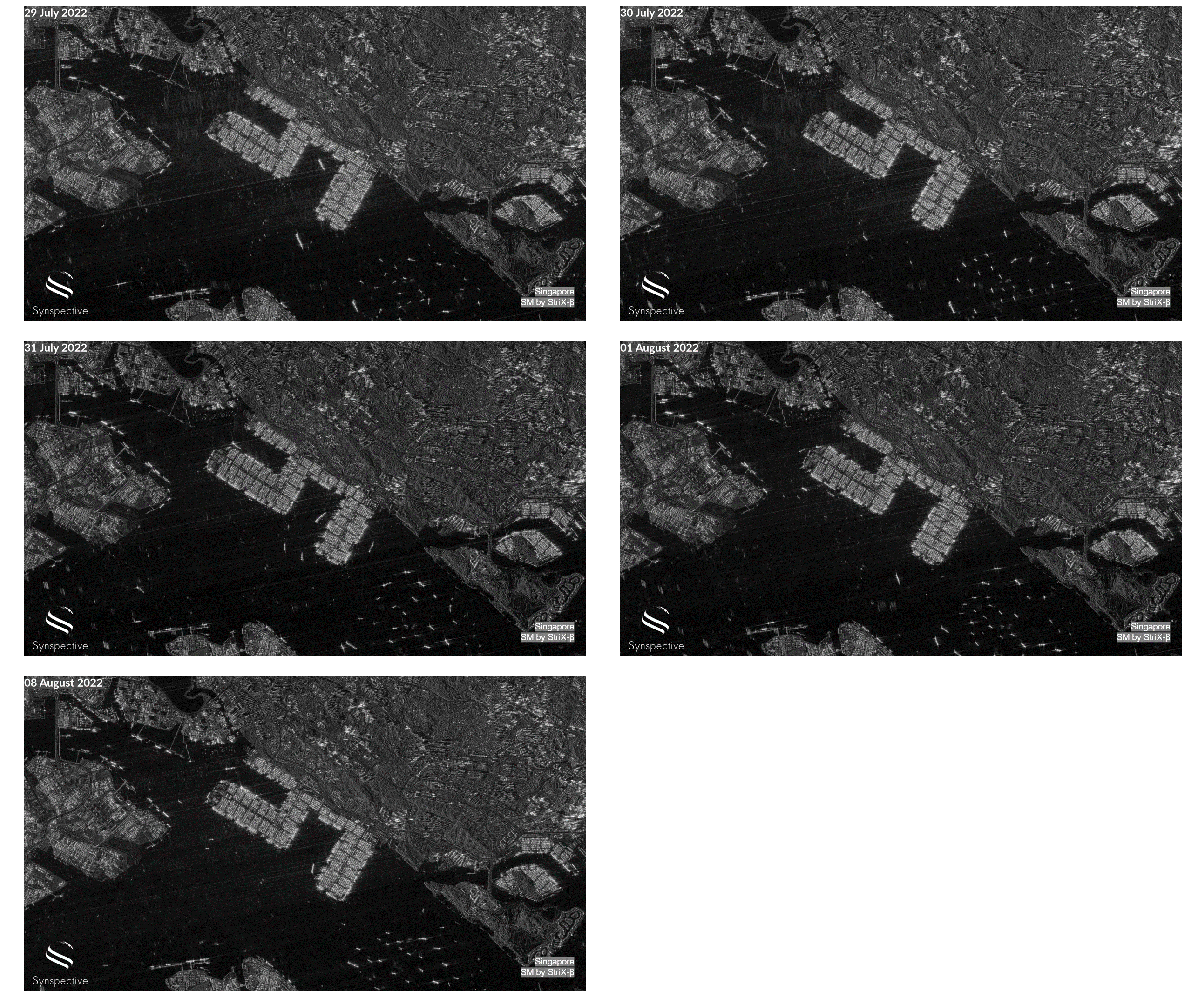
The first is Stripmap Mode, where the centre of the antenna beam moves in conjunction with the satellite at an approximately fixed off-nadir angle, producing a long swath image with a nominal slant range resolution of 1.8 m and a nominal slant-azimuth resolution of 2.6 m.
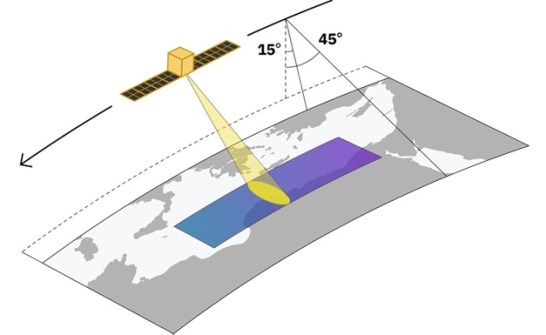
The second is Sliding Spotlight Mode, where the beam is steered during data acquisition to enable longer observation of a selected area. Two modes are available: the first has 0.9 m ground range and 0.9 m azimuth resolution, with the other having 0.46 m ground range resolution and 0.5 m azimuth resolution.
And the third is Staring Spotlight mode, where the beam is concentrated on a smaller area for a longer duration. Four sub-modes are available, including Mode 4, which produces a slant-range resolution of 0.23 m and azimuth resolution of 0.24 m.