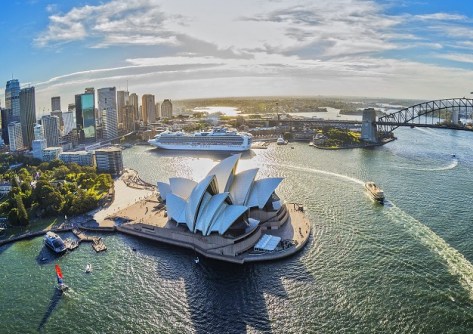
A bid is being made to host the International Society of Photogrammetry and Remote Sensing’s Congress in Sydney in 2030.
The effort is being spearheaded by well-known local geospatial experts Petra Helmholz and Sisi Zlatanova, with the Locus Alliance, headed by Rachel Greenwood, acting as host organisation.
The vote on which city will be awarded the honour of hosting the 2030 event will be taken in July at this year’s ISPRS Congress in Toronto, Canada.
The theme for Sydney’s bid is ‘Caring for Earth and People: Past Wisdom, Future Vision,’ which is intended to evoke a vision of a “global forum where geospatial science contributes meaningfully to sustainability, disaster resilience and improved human wellbeing”.
The bid’s logo is entitled nakiliko malang, which means ‘see together’. The bid states that the design represents Sydney as “a global gathering place where knowledge, ideas and purpose come together, grounded in Country. The patterns draw on both aerial observation and ancient ways of reading land, while flowing pathways connect sky, land and water. Circular forms symbolise collaboration and global community, and layered elements highlight different ways of seeing the world.”

Building on Australia’s strengths
“What makes an ISPRS Congress special is the depth of science, the strong links between research and practice, and a genuinely global community coming together around shared challenges and opportunities,” said Petra Helmholz, A/Prof Photogrammetry at Curtin University.
“Australia has been an active part of this story for decades. Across photogrammetry, LiDAR, Earth observation analytics, GeoAI, and digital twins, Australian researchers and industry partners are not only advancing methods but also deploying them at scale,” she added.
“Examples include Digital Earth Australia, which delivers decades of analysis-ready satellite data for national environmental monitoring and disaster response, and the NSW Spatial Digital Twin, which integrates 3D and 4D geospatial data to support infrastructure planning, emergency management and urban resilience.”
Helmholz says that hosting the ISPRS Congress in Sydney “would build directly on this strength”.
“It would give the global ISPRS community access to a highly connected research ecosystem in the Indo-Pacific region, while creating space for deeper conversations about applied innovation, capacity building and long-term impact,” she said.
Other ISPRS events
The Congress was last held in Australia in 2012, in Melbourne, under the theme of ‘Imaging a sustainable future’. Those interested can still access the proceedings on the ISPRS website.
The most recent ISPRS event in Australia was the Technical Commission IV (Spatial Information Science) Symposium held in Fremantle in October 2024.
Following on from Toronto, the next big ISPRS event will be the Geospatial Week meeting to be held in Warsaw, Poland, from 19 to 24 September 2027.
Held every second year on odd-numbered years, the Geospatial Week primarily comprises a series of workshops organised by the various ISPRS working groups.
The significant dates for 2027 are:
- October 15, 2026 – Call for papers and registration opens
- April 15, 2027 – Full paper submission and early bird registration deadline
- May 15, 2027 – Abstracts submission deadline
- June 15, 2027 – Author notification
- July 15, 2027 – Camera-ready paper submission
- September 15, 2027 – Late registration deadline