
The bid to set up an Australian national positioning, navigation and timing (PNT) research centre has been shortlisted for funding.
The proposal for the Secure, Hardened, Integrity-Enhanced, Location and Timing Defence (SHIELD) CRC has successfully made it through the Stage 1 elimination round.
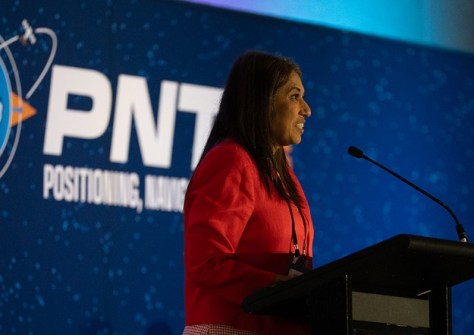
“This milestone reflects the extraordinary commitment and collective expertise of our industry, government and research partners,” said Allison Kealy, Professor in Geodesy/PNT and Director of the Innovative Planet Research Institute at Swinburne University of Technology.
“Together, we are working to build the sovereign capability, technologies and workforce Australia needs — while contributing to the international effort to secure resilient PNT.
“A huge thank you to every partner, research leader and member of the bid team who helped us reach this point.”
The SHIELD CRC bid will now progress to Stage 2, where it and three other proposed CRCs will be further assessed and challenged on their plans.
The other three bids that were successful in Stage 1 are:
- Australian Air Mobility CRC
- Trustworthy Digital Society CRC
- Future Freight CRC
Australia’s critical PNT vulnerabilities
According to Professor Kealy, developing and maintain resilient positioning, navigation and timing systems is a global challenge.
“For critical infrastructure, from telecommunications to transport, defence and emergency services, the systems we rely on every day depend on trusted and assured PNT,” said Professor Kealy.
“As threats from interference, disruption and geopolitical uncertainty grow, strengthening resilience has never been more urgent.”
As a prime example, Kealy points to the recent disruption to Telstra’s services due to a simple equipment timing error that took down the system. That’s all it takes, whether it’s accidental or deliberate.
According to a recent report on Australia’s vulnerabilities to PNT disruption, “Essentially, Australia’s PNT posture lacks the diversity, redundancy, resilience to manage contemporary threats that are both emerging and that can be layered across a continuum of strategic conditions (cooperation, competition, conflict),” the report says.
“Adversaries could view Australia’s lack of PNT signal diversity as an opportunity to create disruption. Indeed, disruptions to PNT have become a routine modus operandi in the grey-zone state, and these only escalate and amplify during conflict.”
PNT is, of course, at the heart of all the professional geospatial systems that our modern world relies upon.
$157 million promised from SHIELD CRC bid partners
With the SHIELD CRC bid winning through to Stage 2, “Australia is now one step closer to a coordinated national response,” said Professor Kealy.
Stage 2 involves presenting the federal government with more modelling to demonstrate the expected economic impact of the CRC, should it be funded.
CRCs operate under a model that comprises cash and in-kind contributions from universities, the private sector and others, matched with federal government funding.
So far, the SHIELD CRC has obtained promises of $57 million in cash contributions and another $100 million of in-kind contributions from about 35 partners, spread over 10 years.
The bid team now needs to submit the extra information required to the federal government by 17 September 2026 and undergo an interview process in November.
The successful proposals out of the four candidates will be announced in early 2027, with funding to commence in July 2027.
Related reading:
Australia needs stronger leadership on PNT risks
CRC bid to shore up Australia’s GNSS resilience