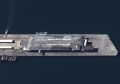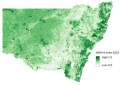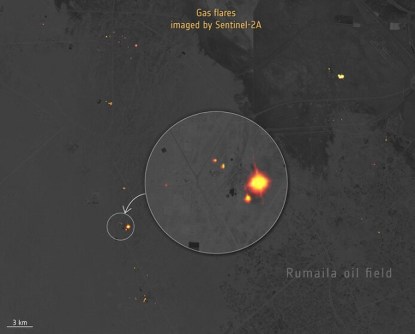
Europe’s Sentinel-2A Earth observation satellite has been giving a job on the nightshift.
The spacecraft, launched in June 2015 and now approaching the end of its life, has been pressed into service to undertake test imagery of the Earth’s surface during the nighttime segment of its orbits… something it was not originally designed to do.
The Sentinel-2 mission always comprises two satellites, which for a long time were the -2A and -2B spacecraft, the latter of which was launched in March 2017.
Following the launch of Sentinel-2C in September 2024, the original -2A spacecraft was slated for retirement. But demand from the global user community convinced managers within the European Union’s Copernicus Programme to keep it in operation for an extended period.
With that decision made, a pilot program was initiated to take the opportunity to test -2A’s ability to take imagery at nighttime. Normally, the -2-series satellites’ imaging systems are switched off during the ‘dark’ portion of their orbits.
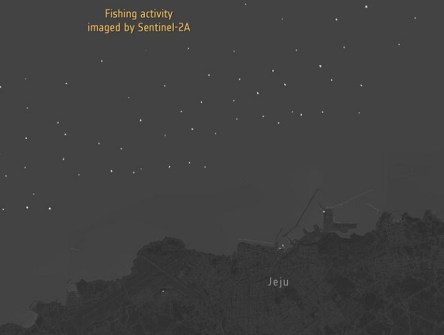
The test data being gathered is of special interest to those designing the ‘follow-on’ series of spacecraft — known as Sentinel-2 Next Generation — which will have the ability to take nighttime imagery over certain regions of the planet.
Payload characteristics
Each current-generation Sentinel-2 satellite carries just one imaging payload, called the Multi-Spectral Instrument, which is capable of capturing imagery in 13 spectral bands at different ground resolutions:
- 10m-resolution bands: RGB (blue: ~493nm; green: 560nm; red: ~665nm) plus near-IR (~833nm)
- 20m-resolution bands: Four narrow bands in the VNIR vegetation red edge spectral domain (~704nm, ~740nm, ~783nm and ~865nm) and two wider SWIR bands (~1,610nm and ~2,190nm)
- 60m-resolution bands: Used mainly for cloud screening and atmospheric correction (~443nm for aerosols and ~945nm for water vapour) and cirrus detection (~1,374nm)
- Swath width: 290 kilometres
- Focal plane assemblies: Visible and near-IR (10 wavelengths), and shortwave IR (3 wavelengths)
- Data download: Up to 1.6 terabytes of raw data per orbit
Sentinel-2 spacecraft operate in a common orbit but spaced 180 degrees apart. Following the launch of Sentinel-2C to replace -2A and complement -2B, -2A was shifted to take up a position 36 degrees from -2C.
The upshot of this has been a temporary increase in observation frequency. Having -2A operate as a third satellite provides additional observations two days apart from Sentinel-2B and one day apart from Sentinel-2C.
Nighttime imagery tests
The nighttime imagery experiment was “carefully prepared by the mission teams, and it has naturally put strain on the Sentinel-2A satellite, but it has been well worth exploring what this ageing satellite can do to help prepare for the future,” said Ferran Gascon, the European Space Agency’s Sentinel-2 Mission Manager.
“Switching on the satellite to image at night required a great deal of energy, but Sentinel-2A did very well.
“Even after 10 years in orbit and this demanding experiment, the satellite is still in remarkably good health and continues to deliver a wealth of data to many users that benefit from the satellite for a wide range of everyday applications.”
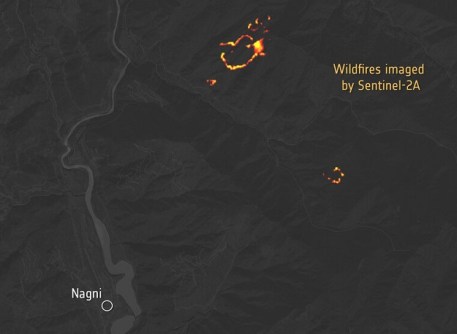
“We are extremely pleased with these results, which help pave the way for the Sentinel-2 Next Generation mission,” added Simon Proud, the European Space Agency’s Sentinel-2 Next Generation Mission Scientist.
According to Proud, the experiments “are providing invaluable insight as we design Sentinel-2 Next Generation, which is being developed with the ambitious goal of delivering even higher resolution imagery and imaging some parts of the planet even when the Sun is down”.
Not ready to retire
The question is, how long will Sentinel-2A continue to operate?
Commenting in February last year, Christoph Kautz, Director for Satellite Navigation and Earth Observation at the European Commission, said “Sentinel-2A will not retire yet”.
“As of this March [2025], Sentinel-2A will be operated to complement the Sentinel-2 mission data acquisition plan. This pilot activity will last one year,” he added.
“Afterward, together with ESA, we will assess the outcomes and decide on its potential prolongation.”