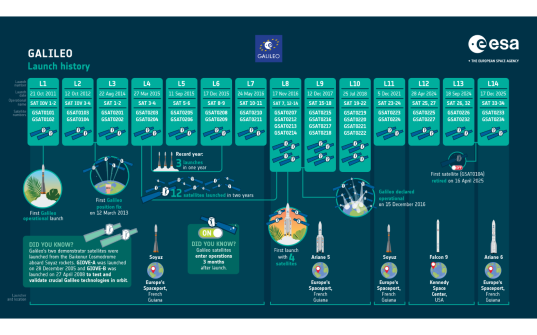
The latest two Galileo satellites have been rocketed into orbit aboard an Ariane 6 launch vehicle.
The launch took place on 17 December from Europe’s Spaceport in French Guiana, and marked the first time that Galileo spacecraft had been launched aboard an Ariane 6.
Less than five hours after lift-off, satellites SAT 33 and SAT 34 successfully deployed their solar panels and sent the ‘all clear’ signal back to Earth.
Following a period of in-orbit testing, the two spacecraft will join the operational Galileo constellation in medium Earth orbit, at which point the constellation will have 29 active satellites.
“The year 2025 marks three decades of European navigation programmes and the successful launch of two new Galileo satellites is another proud and well-earned moment in that legacy,” said Josef Aschbacher, ESA’s Director General.
“Galileo stands as the world’s most accurate global navigation satellite system – and today we have increased its reliability and robustness.”
“Soon, we will be adding Galileo Second Generation satellites which will deliver even more robust and reliable positioning, navigation, and timing services,” added Francisco-Javier Benedicto Ruiz, ESA’s Director of Navigation.
“They will integrate seamlessly with the current fleet to form Europe’s largest satellite constellation and provide essential services worldwide”.
According to ESA, Galileo is “the world’s most precise satellite navigation system,” with its High Accuracy Service providing dedicated receivers with horizontal accuracy down to 20 cm and vertical accuracy of 40 cm.