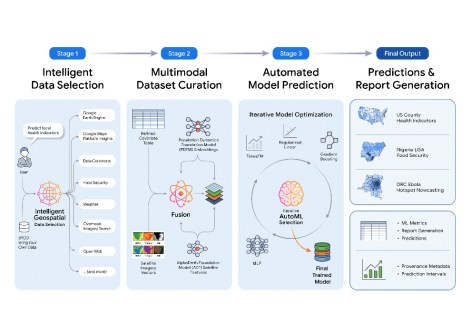
Google Research has announced the release of the Planetary Prediction Engine (PPE), an experimental capability designed to automate full geospatial workflows from natural-language queries.
PPE has been developed as part of the wider Google Earth AI program, and is designed to ‘bypass’ the bottlenecks in spatial data analysis — particularly at global scale — by handling all tasks from data discovery to model evaluation.
According to Google, geospatial analysts and researchers have long been held back a system that involves collating fragmented and often hard-to-source data ecosystems that then need weeks of manual retrieval, cleaning and integration.
PPE is designed to solve, or at least improve on, these problems, by using off-the-shelf LLMs to serve as orchestrators within three modular stages:
- Intelligent data selection
- Multi-model dataset curation, and
- Automated model building
Three-stage approach
The first stage, intelligent data selection, will see natural-language prompts translated into specific geographic constraints, spatial granularities and temporal scopes. PPE will query established data repositories such as Google Earth Engine and Data Commons while also conducting a live discovery process across open-web government and academic portals, looking for relevant data and signals.
Stage two will fuse those results with trained geospatial foundation model embeddings, such as Population Dynamics Foundation Models for socio-economic work and AlphaEarth for satellite imagery.
The third and final stage will shift to optimisation, testing multiple model families — such as regularised linear models, gradient-boosted decision trees, and multi-layer perceptrons — while employing what Google calls an ‘overfitting guard protocol’ to secure model validity.
According to Google, this pipeline “effectively reduces the time needed to build complex planetary prediction models from weeks that include manual data engineering to mere minutes that result in autonomous insight”.
A shift toward agentic workflows
Google says that initial testing across multiple benchmarks — ranging from public health indicators to food security and environmental risk assessment — indicates that the automated system can match or improve upon manual baseline performances.
According to the announcement, the tool is intended to shift operational focus toward higher-level analysis.
“By shifting the focus from manual data engineering to high-level hypothesis direction, the planetary prediction engine helps researchers, humanitarian organisations, and policymakers build models without needing specialised engineering teams,” the Google team said.
PPE is still an experimental capability that remains under evaluation, but Google hopes its architecture points to an evolving shift toward agentic, natural-language workflows in the geospatial sector.