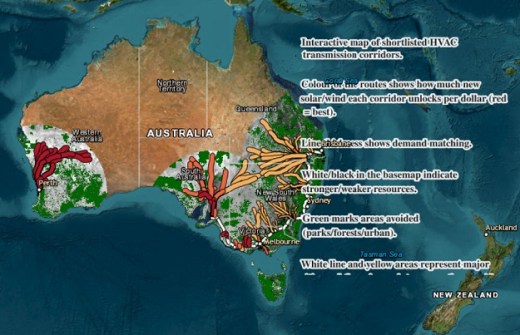
ANU researchers have used GIS analysis to assess the suitability of more than 500 potential new electricity powerline transmission corridors across Australia.
The outcome is a map of the 147 highest-scoring options. An interactive version can be viewed online.
According to the researchers, new powerlines will be needed to unlock vast amounts of low-cost solar and wind power.
“Transmission is now a bottleneck for cheaper, cleaner electricity. Australia is tracking towards 82 per cent renewables by 2030, but where and how we build new powerlines will determine costs, community impact and reliability for decades,” said the ANU’s Dr Cheng Cheng.
GIS analysis
The researchers assessed the suitability of each location against three key metrics:
- How much new solar and wind potential is unlocked per dollar of new transmission cost?
- How much do solar and wind along a new transmission corridor complement each other to reduce the need for storage? For example, does the wind tend to blow strongly at night and during winter?
- Does it avoid protected areas such as towns, native forests and national parks?
In their paper, they write that “Solar and wind farms need to be sited where resources are strongest or where social and environmental constraints are minimal. As a result, Geographic Information System (GIS) analysis and renewable resource assessments become critical for balancing technical, economic, environmental and social considerations.”
They go on to say that “This study introduces a novel method designed to unify strategic and tactical transmission expansion planning and bridge the gap between energy system optimisation and GIS-based routing.”
“It provides a cohesive method to systematically generate candidate transmission routes with an accompanying evaluation framework to quantitatively assess the various transmission options.”
Unlocking corridors
Dr Cheng said building new powerlines in the locations they’ve identified could help the country fast track its journey to net zero and help slash Aussies’ energy bills in the process.
“Australia can cut power bills and accelerate the renewable transition by targeting a small set of optimal transmission corridors to unlock top wind and solar zones, reducing system costs by up to 18 per cent,” Dr Cheng said.
“Several good corridors run west from Brisbane into inland Queensland, unlocking vast solar and wind potential in flat and largely cleared country.
“That’s important because of public debate in Queensland over wind farms on wooded ridge tops north of Brisbane. Transmission corridors running northwards from Brisbane have relatively poor potential.”
A growing need
ANU Professor Andrew Blakers said Australia needs six times more solar and wind to reach net zero emissions, highlighting the need for rapid electrification of transport, heating and industry.
“Today’s electricity transmission network will soon be fully loaded by solar and wind farms. New transmission corridors are needed that unlock low-cost solar and wind generation,” he said.
“Regions that host new transmission, solar farms and wind farms will benefit from billions of dollars of economic activity and land leasing fees, and thousands of long-term jobs.”
Dr Cheng said the work highlights the benefit of large solar and wind farms in the Northern Territory and north Queensland to reduce the effect of wet and windless weeks in winter in the south-east.
“These northern locations combine excellent winter resources with manageable distances to Brisbane, Sydney and Melbourne using high voltage direct current transmission,” Dr Cheng said.