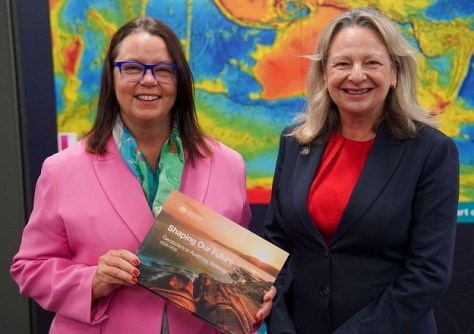
Geoscience Australia has a new 10-year enterprise strategy taking it through to 2036.
Launched this week by the federal Minister for Resources, Madeleine King, the plan sets out how the organisation will contribute to “Australia’s resilience, innovation and prosperity” over the next decade.
“Understanding the Earth beneath our feet – from the Earth’s core up into space and the oceans that surround us – remains fundamental to our resilience, innovation and prosperity,” Minister King said.
“This strategy affirms the importance of Geoscience Australia to Australian life. It recognises that the work it does, the data it produces, and the insights it generates underpin decisions that — although they may not necessarily know it — affect every Australian.”
Applied geoscience
Titled Shaping Our Future: Geoscience Australia Strategy 2026–2036, the plan outlines a commitment for supporting economic growth, managing natural hazards, enabling the transition to net zero and protecting the natural environment.
“Australia’s land and marine environments are vast, diverse and continually changing,” said Geoscience Australia’s CEO, Melissa Harris.
“This strategy ensures our science, data and technology continue to support the nation’s safety, resilience and prosperity for generations to come.”
According to Geoscience Australia, ‘applied geoscience’ underpins around $124 billion in economic value each year.
A long heritage
Geoscience Australia can trace its heritage back to 1946, when Prime Minister Ben Chifley created the Bureau of Mineral Resources, Geology and Geophysics to support and invigorate Australia’s post-war mining industries.
Geoscience Australia was formed in 2001 through the merger of the Australian Surveying and Land Information Group (AUSLIG) and the Australian Geological Survey Organisation (AGSO), to take over that mining sector work and combine it with mapping, positioning and satellite data services.
“Geoscience Australia and its predecessors have underpinned our nation’s prosperity for decades, ensuring we have a prosperous economy and as well as unlocking resources that drive local jobs,” Minister King said.
“Chifley’s decision in 1946 supported the great expansion of Australia’s post-war mining and petroleum industries that have helped build Australia’s modern economic prosperity.”
The national interest
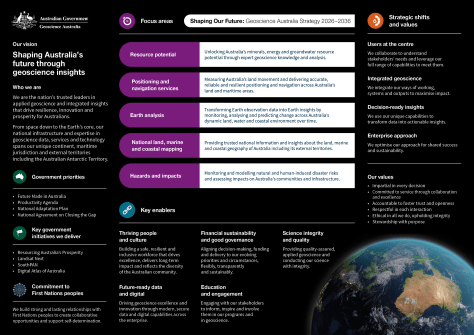
The new Strategy focuses on five national priorities, with geospatial technologies at the heart of each of them:
- Resource potential — unlocking Australia’s minerals, energy and groundwater resources to support economic growth and the energy transition;
- Positioning and navigation services — delivering precise national positioning capabilities that underpin productivity, safety and innovation;
- Earth analysis — transforming satellite and Earth observation data into insights about Australia’s changing land, water and coastal environments;
- National land, marine and coastal mapping — providing trusted national mapping and geospatial information for planning, development and environmental management; and
- Hazards and impacts — monitoring and modelling natural hazards to help protect communities and infrastructure.
Capabilities supporting these major national priorities include the $3.4 billion Resourcing Australia’s Prosperity program, involvement in the Landsat Next satellite project, the SouthPAN SBAS service, and the Digital Atlas of Australia.
Collaborative approach
The Strategy also outlines Geoscience Australia’s ongoing commitment to strengthening partnerships with governments, industry and academia, as well as reinforcing engagement with First Nations peoples.
Geoscience Australia says that it will:
- Put users at the centre of its work;
- Integrate geoscience, ways of working and outputs;
- Deliver decision-ready insights; and
- Take an enterprise approach.
“Realising this vision will take collaboration across government, industry and research partners,” said Harris.
“Together, we can help shape a safer, more prosperous and sustainable future for Australia.”