Early images from the multispectral imaging system aboard the EarthDaily EDC-01 satellite have been publicly released.
The Canadian company says the payload has one of the highest pixel-processing capacities in orbit, able to digitise more than 20 billion pixels per second.
“This moment validates years of shared vision and disciplined engineering between EarthDaily and ABB,” said Don Osborne, CEO, EarthDaily.
“The performance of their imaging technology reflects that dedication and lays the foundation for consistent, trusted Earth intelligence at global scale.”
ABB was responsible for the overall design of the spacecraft, along with Xiphos Systems Corporation payload central processing) and Loft Orbital (Airbus Arrow-150 bus repurposing).
The satellite’s imaging system, which is equipped with proprietary advanced image fusion algorithms, began delivering images in 2025.
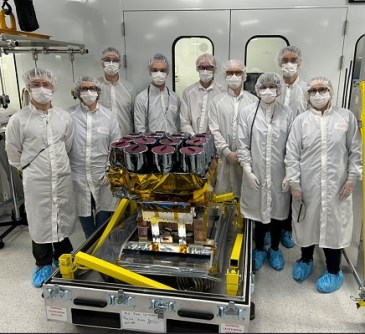
ABB’s compact telescope design integrates 16 multispectral imagers on a single spacecraft bus — 12 visible and near infrared imagers (VNIR), two short wave infrared imagers (SWIR), and two thermal infrared imagers (LWIR).
The satellite also has visible spectrum (RGB) capability, giving it a total spectral range of 22 bands.
According to ABB, early data confirms that the VNIR telescopes are operating near the diffraction limit… a performance often viewed as a ‘holy grail’ in space imaging.
ABB says this performance can be credited to both an innovative, thermally resilient design and to micron‑level alignment tolerances that were preserved during the vibrations of launch.
“Sensor-to-sensor reproducibility is key when operating a 160-camera constellation working as one,” said Frederic Grandmont from ABB’s Measurement & Analytics division, referring to the total number of infrared cameras in the intended 10-satellite constellation.
“On top of vetting the overall design, this early payload data allows for inter-comparison between the 12 VNIRs identical cameras.”
The next six EarthDaily satellites are scheduled for launch in May, with the remainder to follow later this year. The constellation will begin commercial operations in mid-2026.