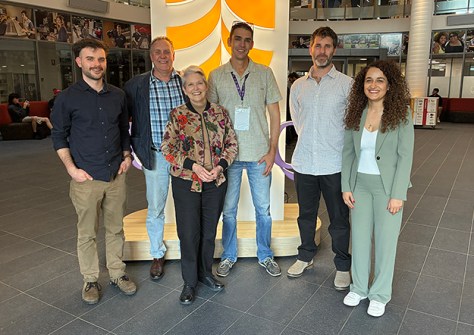
Three students presented their Honours projects this week, each of which was supported by a highly prized bursary.
The students had been awarded their bursaries by the ISAQ Bicentennial Education Foundation (ISAQ BEF), a charitable organisation registered in Queensland.
The ISAQ BEF says its mission is to “nurture and cultivate the next generation of spatial professionals through our scholarship program, providing the industry with qualified and skilled people whilst facilitating the necessary research and knowledge for future innovation”.
The organisation offers a range of scholarship supports, such as the Clem Jones AO and Geoff Wright Scholarship, the Jack de Lange Surveying Scholarship, a Bachelor of Spatial Science (Honours) scholarship, and the bursaries.
Three bursaries are awarded each year to students undertaking the Bachelor of Surveying (Honours) at the University of Southern Queensland, to assist each of them with their Honours projects.
Student selection is adjudicated by an advisory committee according to five criteria, including a statement of need, with the final decisions made by the ISAQ BEF board.
Each bursary is normally $1,000, although higher amounts can be disbursed in some circumstances for unique and impactful research… again, awarded based on merit and a statement of need.
Essential support when it was needed
One of the recipients was Rhys Alexander, whose project was all about reducing subjectivity in mountain biking difficulty rating using phone-based LiDAR and photogrammetry.
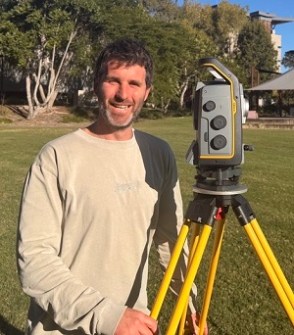
His bursary supported the purchase an iPhone 17 Pro, which was essential for the LiDAR-based data capture central to his research. It was also used for processing software, survey consumables, and travel for fieldwork and GNSS control establishment.
Alexander, who currently works in a role that includes both cadastral and engineering surveying, said the bursary has “enabled me to purchase essential equipment and dedicate time to my research without creating additional financial pressure on my young family”.
“It has allowed me to reduce my work commitments when needed and focus on completing my research project in a timely and professional manner, rather than trying to fit it around after-hours commitments,” he said.
“Receiving the bursary has significantly reduced the mental load associated with balancing work, study and family responsibilities,” he added.
“I feel incredibly fortunate to have received this support, and it has motivated me to produce the highest-quality research report possible as a way of honouring that investment in my education and future career.”
Validating remote sensing results
The second recipient was Iurii Matvienko, whose project used remote sensing monitor the decline of Bunya Pine in Queensland’s Bunya Mountains.
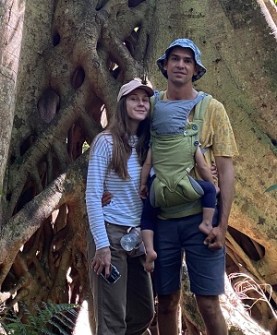
Matvienko used the bursary to defray the expense of the multi-day field trip to ground-truth the remotely sensed results.
“The bursary has enabled me to undertake the field validation component of my research by helping cover the costs of travelling to Bunya Mountains National Park, including fuel and accommodation,” he said.
“During my first field visit, I was able to validate part of the remote sensing results and gain valuable insights into the study area.”
Matvienko found that some of the areas he had planned to survey were not accessible as he had expected due to a lack of walking tracks.
“As a result, I have developed a revised fieldwork plan and will be returning to the park to complete the remaining validation,” he added.
“This additional fieldwork will allow me to further verify the predicted Bunya Pine locations and strengthen the reliability of the final results.”
“Without the bursary, carrying out this essential fieldwork would have been much more difficult.”
Classifying invasive plant species
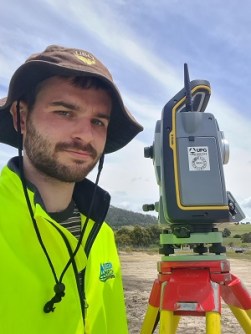
This year’s third recipient was Connor Fox, whose project was to conduct a comparison of remote sensing platforms and classification methods for the classification of Lantana Camara and Opuntia tree pear in a sub-tropical wooded parkland in Queensland.
“As someone from Tasmania with a young family with two small kids, the bursary provided me with the opportunity to fund my flights to, and accommodation in, Brisbane,” he said.
“It also helped fund some additional PC hardware to aid in running graphics intense programs.”
Fox is hoping that his work will provide some important insights into classification algorithms, thereby offering solutions to invasive species classification for prospective researchers and technicians.