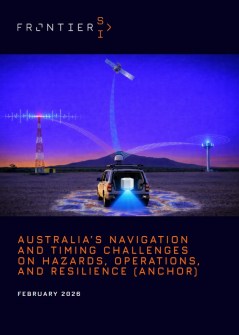
A new report from FrontierSI outlines ways in which to strengthen Australia’s positioning, timing and navigation (PNT) ecosystem to deal with threats and vulnerabilities.
The ANCHOR (Australia’s Navigation and Timing Challenges on Hazards, Operations, and Resilience) report is aimed squarely at governments, the defence establishment and authorities responsible for critical infrastructure and PNT systems.
However, it should also serve as a wake-up call for the wider geospatial community, particularly those who depend upon positioning services — from surveyors in the field to farmers using automatic steering systems in their fields.
The 83-page document is split into two parts. The first looks at the ‘threat environment,’ from both a civil and military point of view. (See our article from last week, PNT assurance in the age of NAVWAR.)
The second part looks at ways to increase the robustness of Australia’s PNT ecosystem, which, for instance, is currently heavily reliant on systems and components supplied from overseas.
Fragmented approach
The report’s authors — Eldar Rubinov (FrontierSI), Jia Lee (FrontierSI) and Joshua Critchley-Marrows (independent consultant) — outline how even small disruptions can have “cascading effects”.
“Australia’s primary reliance on GPS can lead to critical points of failure, limited control over timing services, and potential supply chain choke points,” they write.
“Essentially, Australia’s PNT posture lacks the diversity, redundancy, resilience to manage contemporary threats that are both emerging and that can be layered across a continuum of strategic conditions (cooperation, competition, conflict).
“Adversaries could view Australia’s lack of PNT signal diversity as an opportunity to create disruption. Indeed, disruptions to PNT have become a routine modus operandi in the grey-zone state, and these only escalate and amplify during conflict.”
There is also the problem that responsibilities for PNT provision and security are fragmented across government and industry. There’s no single entity responsible for it.
“This fragmentation weakens Australia’s ability to recognise and respond to PNT threats, and therefore hinders the coordination of timely and effective deterrence and response measures,” the authors write.
“PNT threats are often associated with deliberate interference events, such as jamming and spoofing.
“However, there are a broader range of physical, natural, cyber and information, supply chain, and personnel hazards that are not readily recognised as PNT threats, despite their potential to degrade the availability, integrity and trustworthiness of PNT services.”
Recommendations
The report makes four primary recommendations.
The first is to define a “nationally coordinated threat-driven and risk-based” set of requirements for PNT resilience, which should “establish clear, nationally consistent requirements that specify the level of PNT resilience needed to maintain essential services and national security functions”.
The second is to undertake feasibility studies of PNT architectures to meet these requirements by evaluating a range of complementary and layered PNT architectures to determine their technical feasibility, cost, scalability, and ability to meet both civil and defence PNT resilience requirements.
The third recommendation is to review existing policy, regulatory and standards frameworks to support resilient PNT outcomes.
The final recommendation is to work out an Australian PNT strategy that clarifies roles and responsibilities across Defence, civil agencies and industry.
Other observations include that:
- A mix of space- and ground-based PNT capabilities can reduce vulnerabilities;
- Industrial and economic policies, such as supporting home-grown technologies, can reduce reliance on fragile supply chains; and
- Systems and equipment should be hardened against interference and cyber-attacks.