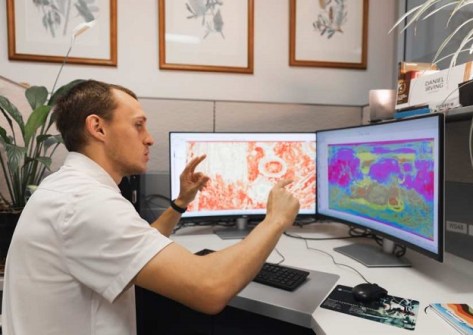
If we are ever to colonise Mars and grow food, we will need to know where the best locations are.
A PhD student at the University of Sydney has produced the first comprehensive classification system and map of Martian soils, creating a new framework that could help scientists compare landscapes across the Red Planet and identify promising locations for future exploration, habitation and food production.
The research, led by Daniel Irving from the Sydney Institute of Agriculture and the Faculty of Science, proposes a new term for Martian soil classes: ‘areths,’ derived from Ares, the Greek name for Mars.
Published in the soil science journal Catena, the research uses orbital observations and models to classify almost 800 million locations across Mars into a hierarchy of 2,000 soil classes and presents a global map showing where they occur.
“This is the first time a classification system of this scale has been developed for Martian soils,” Irving said.
“Scientists have mapped Mars’ geology, mineralogy and chemistry before, but our system brings together multiple properties into a single framework, helping us understand how different Martian soils relate to one another and where they’re found.”
“A future greenhouse on Mars would need more than air, water and light,” added Irving’s supervisor, Professor Alex McBratney. “Its builders would also need to know what lies beneath to understand better starting points for growing plants.”
The Provisional Polythetic Areth Classification System, or PPACS, groups Martian soils into 10 major ‘realms,’ 100 ‘assemblages’ and 2,000 detailed ‘forms,’ based on properties including texture, mineralogy, pH and profile thickness.
The classification is accompanied by a detailed map covering 92% of the Martian surface, allowing researchers to visualise the distribution of different soil types.
Beyond science fiction
The prospect of growing crops on Mars has long captured the public imagination, most famously in the film The Martian, in which astronaut Mark Watney, played by Matt Damon, survives by growing potatoes in Martian soil.
While a greenhouse on Mars remains firmly in the future, Irving‘s research offers a scientific starting point for understanding which Martian soils might be best suited to supporting plant growth under controlled conditions.
As a proof of concept, the researchers assessed all 2,000 soil classes for characteristics important to plant production, including water-holding capacity, pH, profile thickness, clay content and gravel content.
One soil class, known as Nohibareth, emerged as the most promising candidate, scoring 0.93 on the study’s zero-to-one grading scale.
The map places this class particularly in the mid-latitudes of Mars, around Tharsis, central Arabia Terra and Elysium Planitia. Nohibareth soils are found on 0.14 percent of Mars’ surface.
These areas are candidates for closer investigation, not selected greenhouse sites. Among the assessed properties, water holding capacity was the limiting factor in 73 percent of forms studied.
Classes in the Fareth to Mareth realms all scored below 0.3 in this initial test, reflecting less favourable combinations of the properties considered.
The researchers stress that this does not mean crops could be grown directly in Martian soil.
Future habitats would still require controlled environments, water, nutrients and treatment of potentially harmful substances.