This year’s Vivid festival would not have been the success it was without some behind-the-scenes geospatial technology.
Vivid brings Sydney’s nightscape to life through large-scale, full-colour projections onto buildings and other structures.
The vital backbone of those projections is LiDAR scanning.
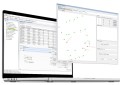
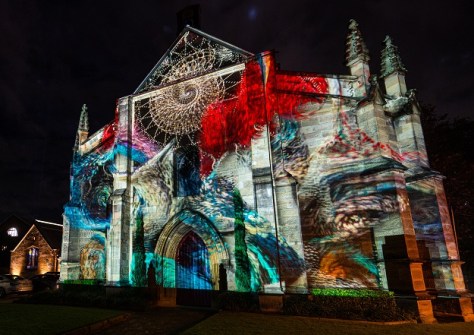
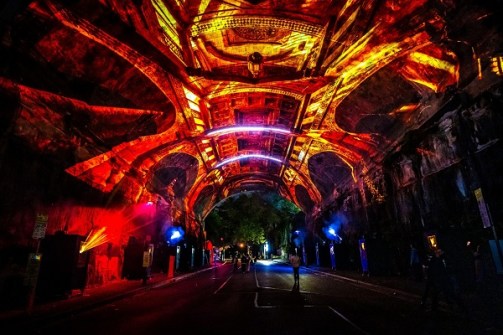
Ahead of this year’s festival, the Technical Direction Company (TDC) — which has been associated with Vivid for more than 15 years — re-scanned both Garrison Church and the Argyle Cut to produce highly accurate digital replicas of the sites.
Those digital models were then converted into projection-ready environments, enabling artists anywhere in the world to design, test and refine their works against Sydney’s architecture long before arriving on site.
“The process helps artists better understand scale, surfaces, proportions and architectural details while significantly reducing development time and increasing projection accuracy,” said Drew Ferors, Head of Innovation and Training at TDC.
Advanced projection technology
Billed as Australia’s largest festival of light, music, ideas and food, Vivid is owned, managed and produced by Destination NSW.
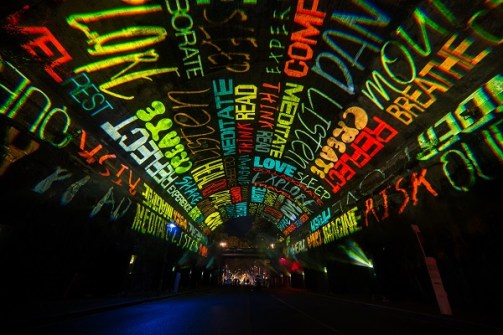
This year, as well as powering 11 installations with the most advanced projection and LED display technology, TDC also created The Daydream Machine, an AI-powered interactive installation that transformed Darling Harbour’s Pier Street Underpass into a living digital artwork.
“By harnessing cutting-edge technologies such as AI, this work creates ever-changing experiences that encourage exploration, play and imagination,” said Vivid Sydney Festival Director, Brett Sheehy.
“For years technology has been used to support artistic ideas. What we’re now seeing is technology becoming a creative tool for artists and storytellers,” added Michael Hassett, TDC’s founder.
“It’s responsive, intelligent and capable of creating completely new forms of audience interaction.”
The outcome was a staggering 547 million projected pixels illuminating Sydney landmarks each night… enough digital content resolution to fill more than 65 4K televisions running simultaneously.
Vivid bringing buildings to life
Each year, TDC reviews and updates digital site models for selected locations to improve projection outcomes and make the creative development process more accessible for artists.
The newly re-scanned Argle Cut was the venue for a display entitled Time: Warped, which combined lasers, lights, sound and projections.
The Garrison Church was transformed into a journey through Earth’s 4.54-billion-year ecological evolution via projections.
“What audiences experience on nights walking around the city takes months of collaboration between Vivid Sydney, individual artists and the team at TDC,” said Creative technologist and TDC Technical Project Manager, Alex Rendell.
“Our role is bringing all those creative and technical systems together, from advanced Projection and LED systems through to media servers, TDC Live View monitoring and interactive technologies, so the artwork can come seamlessly to life for everyone’s enjoyment.”
The following video from a few years ago, shows how it is done.