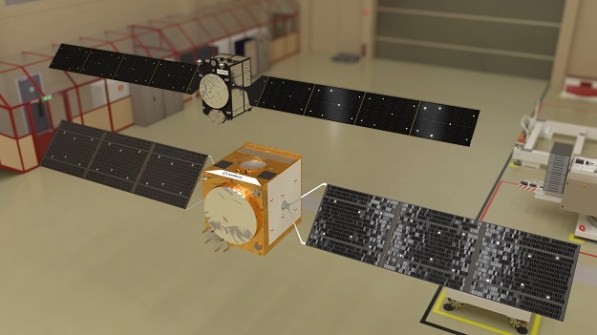
The second generation of Galileo GNSS satellites will feature radio links that will let the satellites talk to each other.
The inter-satellite radio communication links will enable signals to be sent between the satellites during times when one or more of them are out of sight of ground stations.
This mean that a signal can be sent from a ground station to one satellite, which will then pass it on to another spacecraft in the constellation.
In order to do this, each of the satellites will need to be equipped with two small, steerable dish antenna units made rugged and reliable enough to work flawlessly for a decade and a half.
The steering units for those antennae have recently been put through their paces here on Earth to test their reliability.
Tested 15 million times without failure
Amazingly, these steerable units will need to reorientate themselves every 40 seconds for 15 years — that’s 12 million reorientations over the satellites’ lifetimes.
One of the units recently completed a seven-month-long test in Switzerland, successfully reorientating itself 15 million times without failure.

A separate test unit has successfully passed vibration and electromagnetic compatibility testing.
The first two antenna pointing units from Airbus Defence and Space have been delivered to TESAT in Germany, and will now be incorporated into the communications link module and, eventually, a full Galileo satellite.
Second-generation Galileo navigation satellites
The work to deliver the 12, second-generation Galileo satellites has been spilt into two, with six-satellite contracts being allocated to Thales Alenia Space and Airbus Defence and Space.
The modernised Galileo spacecraft will feature a range of upgrades and improvements over the earlier satellites, including:
- The aforementioned inter-satellite radio links
- Electric propulsion — slower but more efficient
- Improved signals
- Reconfigurability in orbit
- Six atomic clocks instead of four
- Expected lifetimes of 15 years instead of 12
A new generation of atomic clocks for Galileo
The current first-generation Galileo satellites are equipped with four atomic clocks — two passive hydrogen maser clocks and two rubidium atomic frequency standard clocks.
But atomic clock technology has moved on since the Galileo system was first defined, and that’s why the new satellites will carry newer technologies.
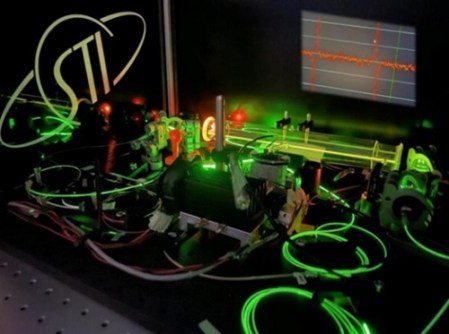
There are three new clocks from three different companies currently under development, shortlisted from seven original contenders:
- Leonardo is already working on a rubidium pulsed optically pumped clock, which will first fly as an experimental unit aboard a second-generation Galileo.
- SpaceTech is developing an idodine optical clock which, too, will fly in an experimental configuration.
- And Safran Timing Technologies has begun work on a mercury ion clock.
Once the clocks have been tested in space, a decision will be made as to which clock or clocks get the nod for roll-out across the entire new constellation.
Safer satellite laser ranging for Galileo
To ensure the orbit of each Galileo satellite is known with the highest accuracy, ground stations bounce lasers pulses off retroreflectors fitted to the satellites.
The current generation of laser systems pose hazards, however, to aviation, due to the potential for damage to pilots’ eyesight should an aircraft somehow fly through the beam.
That’s why a new ‘eye safe’ laser system using a different wavelength is under development.

Already, a new ground station prototype has been developed by German company DiGOS and commissioned at Matera in Italy.
Due to the eye-safe wavelength, there will not be any need to co-ordinate ranging campaigns with aviation authorities.
The system will also be far more automated, dramatically cutting down on the current human operator-intensive operations.
A testing campaign will be conducted this year.