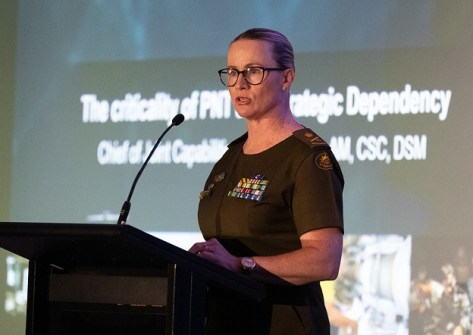
Positioning, navigation and timing within the ADF is a ‘no fail,’ says the Chief of Joint Capabilities.
By Jonathan Nally
Delegates at last week’s PNT2026 conference in Sydney were reminded of the importance of positioning, navigation and timing (PNT) assurance for the defence of Australia.
Presenting a keynote address on the first day of the event, Lieutenant General Susan Coyle AM CSC DSM outlined the ways in which the Australian Defence Force (ADF) relies upon PNT, and why that involves also dealing with its vulnerabilities.
LTGEN Coyle is Chief of Joint Capabilities, a role to which she was appointed in July 2024 and which includes being Chief of Space and Cyber and Chief of National Support.
A highly decorated soldier who has served in roles such as Head of Information Warfare, Commander Task Group Afghanistan and Commanding Officer 17th Signal Regiment, she has extensive first-hand knowledge of the vital role PNT plays in military affairs.
PNT assurance is a ‘no fail’
According to LTGEN Coyle, “Loss of PNT ultimately erodes our combat power, C2 [command and control] and logistics”.
“The ADF’s contribution to a future war will reward those who can manage, protect, and exploit vast volumes of data to achieve decision superiority,” she said.
This includes automated decision making, and synchronising manoeuvres across the land, sea, air, space and cyber domains.
“Every one of these themes depends on assured, trusted, and accurate positioning, navigation, and timing,” she said.
“PNT isn’t a subsystem, it’s the invisible connective tissue of what the ADF calls its ‘integrated force’ — the joint, networked, all-domain force.”
“Therefore, the ADF must assure access to PNT; it is a ‘no fail’.”
LTGEN Coyle added that “Without assured PNT, tempo slows, precision degrades, and synchronisation fails”.
“In the worst case, the integrated force becomes siloed, disaggregated, and blindfolded — connected systems operating in isolation, unaware of each other or the enemy, and vulnerable to exploitation.”
The NAVWAR fight
In addition to the obvious PNT applications of navigation, network timing and secure communications, LTGEN Coyle pointed to other, less obvious aspects of the geospatial ecosystem that operate behind the scenes.
This includes “the science of geodesy that underpins target location accuracy, cryptographic systems that depend on precise timing, and the sensor fusion, geolocation, and battle management systems that tie everything together.”
“PNT is not just a technical enabler, it is a strategic dependency,” she said. “It underwrites the credibility of our deterrence and the trust that commanders place in their force to manage risk.”
“Wherever there is military competition, there is a contest for PNT. We call that contest Navigation Warfare.”
“NAVWAR is the struggle to assure our own PNT, while at the same time denying or degrading an adversary’s.”
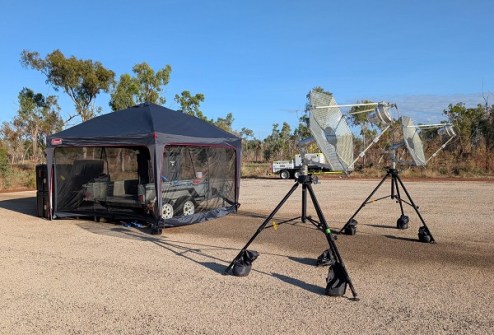
LTGEN Coyle spoke about the problems of GNSS jamming, and particularly spoofing, that are affecting deployed military forces every day. Added to that is the problem of cyber-attacks, and even anti-satellite weapons.
She also highlighted that “Any overreliance on GNSS creates a single point of failure in modern militaries and societies”.
“Given its criticality, it’s no surprise that our adversaries are actively seeking to exploit our dependence on PNT,” she said.
Tackling the challenge
LTGEN Coyle said that, as far as the ADF is concerned, “PNT assurance is a mindset, not just a system. PNT assurance is mission assurance. It demands more than equipment, it requires a NAVWAR mindset.”
“Our goal is to ensure NAVWAR understanding becomes as instinctive across the ADF as electronic warfare is today,” she said.
“That requires education and training at all levels, system awareness and rigorous testing, and deep threat intelligence and understanding of adversary intent and capability.”
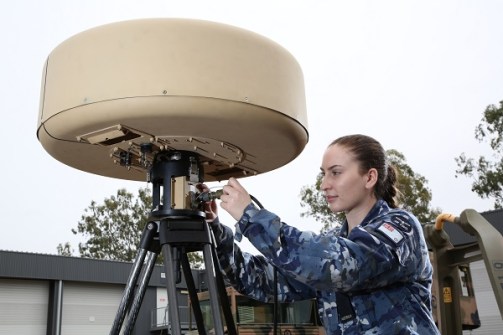
LTGEN Coyle said the ADF’s overall approach is to “inform, toughen, and augment”.
“This approach focuses on multi-layered PNT, fusing a diversity of sources across space-based, terrestrial, inertial, environmental, and advanced timing sources. It focuses on operational resilience, testing and training in degraded environments, and refining tactics, techniques, and procedures.”
“And it focuses on allied interoperability, ensuring coalitions can fight through disruption together, while giving commanders visibility of NAVWAR risks to mission.”
A combined effort
To that end, the Joint Capabilities Group that LTGEN Coyle leads has set up a Joint Navigation and Spectrum Warfare Directorate as a focus for mission assurance across PNT, NAVWAR and electronic warfare.
The Directorate’s PNT Assurance Squadron is monitoring intelligence, conducting field tests, training personnel and evolving tactics and procedures. This also involves engagement with academia, other government entities and international partners.
“Through AUKUS and ASCA [Advanced Strategic Capabilities Accelerator], Defence are advancing next-generation capabilities, including quantum sensors, optical clocks, and undersea navigation capabilities,” LTGEN Coyle said.
“We are delivering our first Defence Time System — a critical step in assured timing and frequency across the Department.”
“And we are embedding PNT assurance across the entire capability lifecycle — from concept and design through sustainment and disposal. Cradle-to-grave PNT assurance.”
“Academia and industry have a critical role to play in building PNT resilience for national security,” she added.
“This is not just a Defence challenge; it is a national endeavour.”