In our regular Spatial Snippets feature, we bring you a round-up of all the bits and pieces of geospatial news that didn’t make it into our normal daily coverage.
Do you have a Spatial Snippet to share with our 8,000-strong newsletter list? Please send us an email.
We’ll begin with some more job news. Geoscience Australia has 14 positions going across 11 different role types, including four that are specific to SouthPAN — Quality Manager, Contract Manager, Project Officer and Assistant Project Officer — as well as navigation, security, certification and systems engineering roles, plus project, procurement and engagement officers. You’ll find them all listed on the APS Jobs site.
Queensland’s Department of Natural Resources and Mines, Manufacturing and Regional and Rural Development has an opening in Mackayfor a surveyor. The role is permanent full-time, and obviously you’d need to have a degree qualification in surveying or a related discipline and be registered with the Surveyors Board of Queensland (or be eligible for registration via mutual recognition).
The Victorian government says it will tip another $1 billion into its Skills First and Free TAFE programs in 2026. The programs are intended to provide free or subsidised training to help people into jobs, with more than 450 courses and 60 accredited short courses to be on offer next year… including a handful that should be of interest to the geospatial community, viz:
- Course in Building Information Modelling (BIM)
- Advanced Diploma of Building Information Modelling (BIM)
- Certificate IV in Surveying and Spatial Information Services
- Diploma of Surveying
- Advanced Diploma of Surveying
The Tasmanian Spatial Information Council (TASSIC) is collecting case studies that “demonstrate the value and benefits of survey and spatial applications in Tasmania,” and has issued a call for those within the sector in the state to submit their own examples. Information on how to do so is available on the TASSIC website.
Another call for case studies comes from the international Group on Earth Observations, which is asking members of the EO community to express interest in contributing potential satellite EO-based case studies for the forthcoming 2026 CEOS Earth Observation Handbook on Adaptation and Resilience. In particular, it is looking for contributions that accord with any of the following themes:
- Water supply and sanitation;
- Food and agriculture;
- Health and well-being/health services;
- Ecosystems and biodiversity;
- Infrastructure and human settlements (including coastal settlements);
- Poverty eradication and livelihoods; and
- Cultural heritage and traditional knowledge.
RSK Group has announced that it is acquiring Civil Geotechnical Consultants (CGC) and adding the company to its Australian division. CGC, which has offices in Brisbane, Cairns, the Gold Coast, Melbourne, the Sunshine Coast and Townsville, has an engineering team of 35 and offers a range of services, including site investigations, construction services and aerial mapping.
In satellite news, Kongsberg NanoAvionics, a manufacturer of small satellites, and IHI Corporation, a premier Japanese aerospace technology leader, have announced the successful launch of IHI-SAT2.
The hyperspectral 6U CubeSat, which is intended to be part of IHI’s future Earth observation satellite constellation, will acquire high-resolution hyperspectral images for advancing forest management and image analysis technologies at NeXT FOREST, a joint venture between IHI and Sumitomo Forestry Company.
In particular, the images will enable wide-area, high-precision forest tree species identification, analysis of growth conditions, and information on signs of disease.
In other satellite news, Rheinmetall and ICEYE have received a €1.7 billion order to supply the German Armed Forces with space-based reconnaissance data via exclusive access to a synthetic aperture radar satellite constellation.
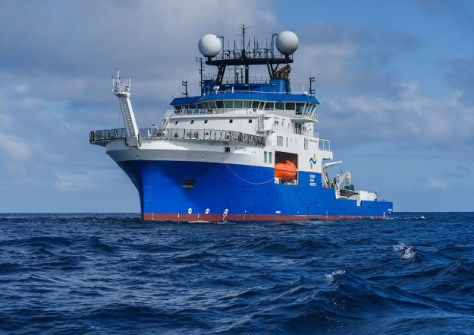
The Schmidt Ocean Institute has announced that it has now mapped two million square kilometres of seafloor — about the size of Greenland — and made two major changes to boost the seafloor mapping capabilities of its vessel, the R/V Falkor. The first change is a modification to replace the ship’s bulbous bow with a more traditional V-shaped bow, which will improve its ability to capture sonar data by eliminating bubbles that were produced by the bulbous bow; it will also enable it to data capture at higher speeds.
The second change is the addition of a new autonomous underwater vehicle, a state-of-the-art Kongsberg Hugin Superior AUV that can operate to depths of up to 6,000 metres, giving it access to 98% of the ocean floor.
This is our last Spatial Snippets for the year. We’ll be back in 2026 with lots more news from the Australian and global geospatial community.
Make sure you don’t miss out any geospatial news from across Australia and around the world — subscribe to our free Spatial Source newsletter, sent out every Wednesday and Friday morning.