A new fact sheet has been released that warns against removing or interfering with survey marks and boundary marks.
The information sheet, ‘Removal or Interference with Survey Marks and Boundary Survey Marks,’ which refers specifically to the rules in Queensland, has been prepared by the Surveyors Board of Queensland in collaboration with the state’s Department of Natural Resources and Mines, Manufacturing and Regional and Rural Development.
The information is aimed primarily at property owners, occupiers and members of the public, and gives general information about the role of survey marks, how they are legally protected, and what people should do if a survey mark is disturbed or can’t be found.
The main points to be noted are that:
- It is an offence to interfere with a survey mark without reasonable excuse, except in limited circumstances.
- Queries about survey mark interference are handled by the Department, and not by the Board.
- Only a registered cadastral surveyor can place or reinstate a boundary mark.
Mark two
The fact sheet explains the difference between permanent survey marks and boundary marks.
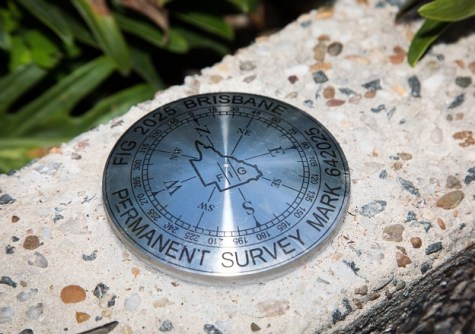
Permanent survey marks (PSM) are long-term reference marks, often taking the form of concrete blocks with attached brass plaques, or small marks set into kerbs.
PSM form part of the state’s geodetic control network and are recorded in the Department’s Survey Control Database, and as such are considered to be items of critical infrastructure that must not be interfered with or removed without written approval from the Department.
Boundary marks, as the name implies, are cadastral survey marks that mark property boundaries. They are often present in the form of white pegs, but can also be nails, iron pins or other marks.
According to the fact sheet, “Boundary marks are usually supported by a nearby reference mark, such as a buried iron pin or a nail in the kerb, to help re-establish the corner if the original mark is lost. Only a registered cadastral surveyor is authorised to place, reinstate or replace cadastral survey marks.”
Dealing with problems
The fact sheet points out that, in most circumstances, it is unlawful to interfere with a survey mark.
Such interference can attract substantial penalties, and even criminal prosecution if a mark is moved or removed with an intention to mislead or obtain a benefit.
In terms of who has jurisdiction, the fact sheet reminds that “The Board does not investigate or take enforcement action against members of the public for interfering with survey marks. The Board’s role is limited to regulating registered surveyors. Where allegations involve members of the public, matters are referred to the Department.”
The fact sheet concludes with information about what to do when boundary marks are missing or cannot be found, and the appropriate avenues for dealing with boundary disputes.