The Australian Urban Research Infrastructure Network, or AURIN, has been serving the national academic community for 13 years.
By Jonathan Nally
Funded by the federal Department of Education as a national research infrastructure facility, AURIN is based at the University of Melbourne, its lead agency, with nodes at other universities around the nation.
As a research support facility, it doesn’t directly deliver research output. Rather, it provides access to financial and digital resources, including high value datasets that researchers would otherwise have a hard time getting access to.
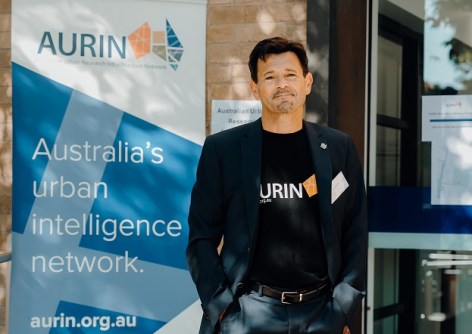
To find about more about AURIN, the work it does and the services it provides to academics, we spoke with its Director, Professor Pascal Perez.
Professor Perez has more than three decades of senior management experience, and prior to taking charge at AURIN served as the director of the SMART Infrastructure Facility at the University of Wollongong. There, he supervised research in fields such as water and energy efficiency, transport and mobility, and smart cities and communities.
What is AURIN’s purpose?
We have a mandate to serve researchers all around the country, regardless of the university they belong to, who are working on urban systems, regional centres, infrastructure systems and/or local communities.
The way we do that is twofold. One is providing what we call ‘hard-to-get’ data, such as commercial data and/or sensitive data: for example, high-resolution data about people. Often, we need to negotiate an access fee with data providers on behalf of the whole research community.
Beyond the price point, a major aspect of the negotiation is to find a way not only to access the data, but more importantly to be able to share it with researchers around the country. So for each data set, we need to find the legal and contractual conditions that allow us to do it.
The second component is providing digital and technological support. For example, cloud deployment or more recently, harnessing the power of AI, especially in the context of geospatial data and reasoning.
We have a mandate to serve researchers all around the country…
With AI, the current generation of LLMs are good at many things and fast improving. However, they don’t understand context. And when you don’t understand context, you cannot reason spatially. It’s impossible, apart from very simple queries. As soon as you start talking about complex analytics, then the fact that you might get a good result is becoming nearly random.
And of course, a logical consequence of our mandate as a national research infrastructure facility is to contribute to the upskilling of the workforce around the country in terms of public research professionals.
So you’re not generating data yourself, you’re providing access to it?
I prefer to call us data brokers, because the negotiation part is a large component of it. We don’t want Australian researchers to have to go through the time and efforts we have to go through — we’re doing it on behalf of everybody else. So, in that sense, we’re data brokers, information enablers.
I always go back to the basics of data, information, knowledge — these are totally different aspects of the same continuum. In this AI world, data is supposed to be everything and the knowledge is embedded in the data. This is totally wrong: there’s no intelligence in data, there’s no smartness in data.
You have to create information out of data. You can have different types of information from the same data set depending on the way you aggregate it, or what kind of sub-sample or what kind of fusion you create with other data sets.
Data, information, knowledge — these are totally different aspects of the same continuum.
And then, you need to move from information to actionable knowledge. Whether you’re a prime minister or a CEO of a firm, you need to be able to do something with the information.
And too often people say, ‘Well, you’ve got a dashboard… you’ve got all your answers now’. So, that’s where we try also to educate and facilitate as much as we can.
What kind of research do you support?
It’s all enshrined in our 2023-28 strategic plan that we created shortly after I arrived as the new director at the end of 2022. We support high-impact research that addresses three challenges that will come as no surprise to anyone — the impact of climate change, the impact of the energy transition, and the impact of demographic transformation on cities, regional centres, infrastructure systems and local communities.
If you think about it, if you take all this together, there are not many topics we’re not covering.
AURIN is currently leading a national initiative on urban climate. At present, our climate models, including the Australian regional models (such as ACCESS-rAM3 or NARCliM 2.0), do not consider urban dynamics. Australian cities, most of which are located on the coast, are — at best — represented by 2D or 3D static tiles. Yet, our cities host 90% of the population, contribute to 80% of GDP, and — unfortunately — generate nearly 60% of our equivalent carbon emissions per year, direct, indirect and enabled.
So cities need more focus?
Cities are point sources that we cannot neglect anymore if we want to really understand the impact of climate change at the level where it matters, which is literally the street block. And we can’t do this at moment because we don’t have the data, we don’t have the models.

From an energy transition perspective, we face similar limitations. Do we have the capacity to support the transition of 50% of the whole fleet of Australian vehicles, light and heavy, to electric power? I don’t think so. Last time I checked, we would have to double our national production and transmission capacity, and I’m not even talking about distribution in cities. Here again, we need more data, better models, smarter insights to guide policies and investment. So, this is another challenge we want to help researchers with.
Finally, demographic transformation. The housing crisis facing Australia is a direct consequence of the misalignment of housing policies and investment with socio-economic trends. The relevant data landscape is highly fragmented, preventing researchers to perform advanced analytics and develop fit-for-purpose models.
This is the reason for AURIN to support the Housing Analytics Lab, at the University of NSW, as a national research infrastructure bridging the gap between academia, government and private sector. The facility aims to inform critical decisions on affordable housing, sustainable housing and intergenerational equity.
Part 2 of our interview with Pascal Perez will appear on Friday, 10 April.