It is an unfortunate reality that wars continue to rage across the globe, with destruction of civilian infrastructure being one of the results.
Researchers from Ludwig-Maximilians-Universität München (LMU) and the Technical University of Munich have developed a method that automatically detects building destruction in conflict zones.
The method does not rely upon the use of commercial satellite imagery or training data but instead uses synthetic aperture radar (SAR) data from the Sentinel-1 mission, which are available at 12-day intervals.
The team applies the InSAR interferometric technique whereby repeated images of the same region are compared and a coherence measure is calculated, indicating how similar the backscattered radar signals are.
A sudden drop in coherence often points to structural changes in buildings, such as damage or destruction.
To ensure that such signals are not confused with random fluctuations, they are assessed statistically. For each pixel, a ‘normal’ pattern of variation over time is estimated, and deviations are quantified using p-value probabilities.
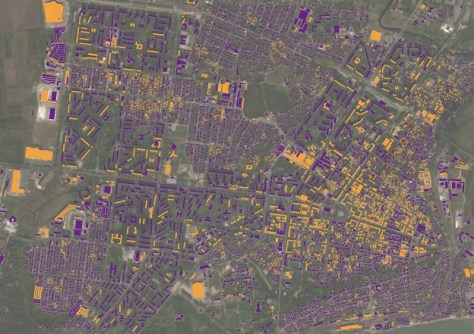
By combining this information with building footprints from OpenStreetMap, the results can be aggregated at the building level, including a measure of uncertainty.
“Using freely accessible data, we can track how destruction evolves across space and time almost in real time,” says Dr Daniel Racek, first author of the study and former doctoral researcher at the Institute of Statistics at LMU.
Using the Beirut port explosion (2020), the destruction of Mariupol following the start of the Russian invasion (2022) and the war in Gaza (from 2023 onwards) as case studies, the method successfully reconstructed both the spatial patterns and timing of building destruction.
The researchers say the approach can function as a fast and cost-effective tool for humanitarian situation assessments, academic research and post-conflict reconstruction planning.
The research was funded by the Munich School for Data Science and the study has been published in PNAS Nexus.