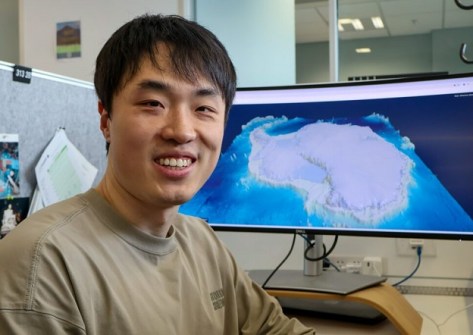
A University of Tasmania PhD student has developed a 3D mapping tool of Antarctic and Greenland ice sheets, for fun, in his spare time.
Yu Wang is nearing completion of his PhD project with the Australian Antarctic Program Partnership, using an ice sheet model to simulate the future of the Wilkes basin in East Antarctica and its contribution to sea-level rise.
“I felt that the incredible datasets our community produces — ice velocity, bed topography, subglacial hydrology, ocean circulations — are completely public data but need a more attractive, accessible and visual way to be presented to a wider audience,” he said.
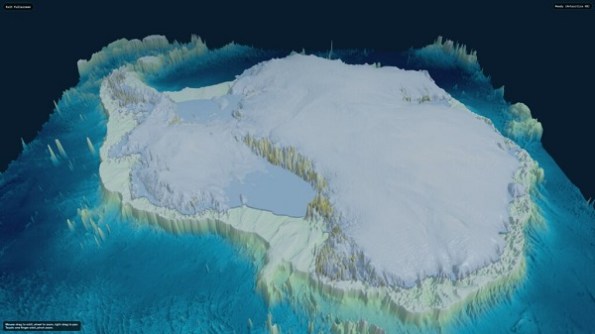
It took Yu about six weeks to build 3D ICE (Interactive Cryosphere Explorer) and “peel back the ice to uncover a hidden world”.
Incredibly captivating
The project is Yu’s first foray into ‘vibe-coding’.
“I learned about OpenAI’s new experimental desktop AI coding agent, Codex, and decided to give it a try,” he said.
“I fed my local Antarctic ice geometry and topography data to the AI and used natural language to describe the interactive 3D visualisation I wanted to achieve.”
“To my surprise, after about ten minutes, I had a smooth, beautifully rendered interactive website. This was the first prototype of 3D ICE,” Yu said.
Once started, the ice sheet project took up much of his free time.
“I became a bit addicted to it; whenever I had a spark of inspiration or a new idea, the AI agent could rapidly bring it to life. This immediate positive feedback loop — honestly, much like playing a video game — was incredibly captivating.”
“I derived endless fun, a sense of accomplishment, and pure satisfaction from the process. I would often do some vibe-coding right before bed, and before I knew it, it would be 2:00 or 3:00 am.”
Exploring model behaviour
The 3D ICE tool integrates the latest datasets for the ocean, ice and terrain of Antarctica and Greenland into a single interactive platform.
Yu reached out to his colleagues for advice, such as physical oceanographer and climate researcher Dr Fabio Boeira Dias at the Institute for Marine and Antarctic Studies.
“I provided Yu with outputs from present-day simulations of the Whole-Antarctica Ocean Model — a modelling effort developed in collaboration with Dr Ben Galton-Fenzi (AAD, and one of Yu’s PhD supervisors), Dr David Gwyther (UQ, UTAS), Ole Richter (now at University of Rostock, previously at UTAS), and Petteri Uotila (University of Helsinki),” Dr Boeira Dias said.
“This circum-Antarctic model simulates thermodynamic ice shelves and tides across the whole continent at 2km resolution,” Dr Boeira Dias added.
“Yu had the data running on the website in less than 24 hours with the assistance of AI — remarkably fast!”
“With his tool, I can readily visualise aspects of the ocean circulation that are difficult to interpret in standard 2D-plots, making it a valuable resource for exploring model behaviour and the interactions between ocean currents, topography and ice-shelf cavities,” said Dr Boeira Dias.
Rich combinations
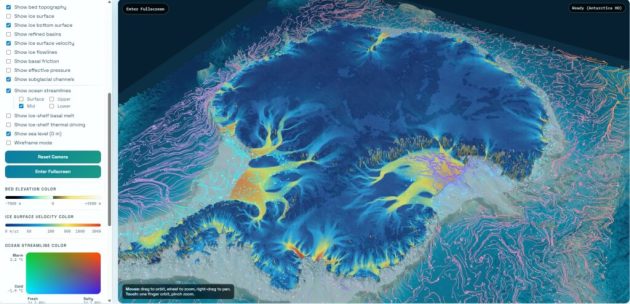
Yu said that 3D ICE can be more than a visualisation tool, serving as a central hub for high-quality data.
“Researchers can use the 3D interface to find and interactively visualise the data they are interested in, and then click a direct link to download it straight from the source.”
“Users can freely combine and explore different data layers to discover inherent connections between various features — and these rich combinations can often lead to unexpected discoveries.”
In addition to research, Yu sees potential for teaching and science communication.
“The website format is easy to disseminate and does not require any specialised software,” he said.
“I could be presenting at a conference, and the audience could scan a QR code on my slides, enter the website, and directly see and interact with my model results right on their own phones.”
“I want our cutting-edge, professional research in the cryosphere to be truly understood by the broader public,” he added.
“Antarctica is not just some distant, irrelevant, frozen continent; it is a critical element that is deeply intertwined with all of us and will profoundly shape the future destiny of human society.”