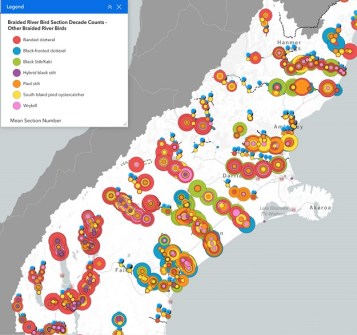
A GIS-based mapping platform has brought together more than 60 years of New Zealand braided river bird survey data into one accessible public database.
Hosted on the Canterbury Maps portal, the tool collates and visualises data from around 15 agencies and groups, including the Department of Conservation, the Canterbury Regional Council (Environment Canterbury), and local river care groups.
The project is the result of a collaborative effort to preserve, enhance and understand New Zealand’s unique ‘braided river’ ecosystems and the more than 80 bird species that depend on them.
“This is something people have wanted for decades,” says Miles Burford, Environment Canterbury Senior Science Analyst.
“Once we developed something for internal use, it made sense to scale it up to serve the whole region.”
Rich data
Ellery Mayence, DOC’s Principal Science Advisor for rare and threatened ecosystems, which includes braided rivers, says the tool takes the dataset to the next level.
“Visualising it through GIS transforms it from a spreadsheet into a decision-making tool,” he said.
“It becomes a way to look at bird populations over time, across catchments, and alongside land use changes like agricultural intensification as well as changes to weed cover.”
Because many of these species are highly mobile and exhibit seasonal patterns, the spatial context is crucial.
“It’s only in the past several years that this data has become detailed and rich enough to back up what we’re seeing on the ground, yet this is only for some species,” he adds.
The platform enables users to explore patterns in bird diversity, species distribution, and changes in river use across decades.
Species in decline
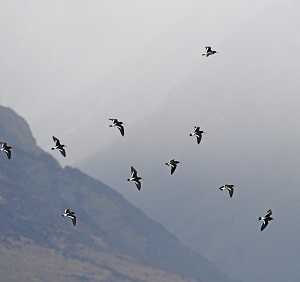
Using the platform and the data it provides, researchers from Manaaki Whenua Landcare Research have carried out new region-wide analysis of tōrea (South Island pied oystercatcher) populations.
The findings show the tōrea is in decline, warranting a higher threat classification and a conservation approach that focuses not only on breeding success, but on survival across its entire annual cycle.
“Species that migrate over long distances face some of the greatest conservation pressures, yet they are also among the most difficult to track,” said Environment Canterbury Principal Biodiversity Advisor, Frances Schmechel.
“It demonstrates the value of large‑scale, long‑running datasets like the braided river bird counts, which help fill that critical gap.
Evidence to act upon
By bringing decades of scattered records into a single, accessible public database, the platform has enabled scientists to analyse tōrea data in ways that were not previously possible.
The study found population declines are most strongly linked to sub-adult survival.

This means conservation efforts must extend beyond nesting sites, addressing pressures tōrea face throughout the year, including during migration and in non-breeding habitats.
“This tool turns decades of observations into evidence we can act on,” said Environment Canterbury Senior Science Analyst, Miles Burford, whose work georeferencing historic counting sections and maintaining the database has transformed paper records into a powerful digital resource.
“We’ve converted a vast amount of historic information into a format that’s accessible and usable,” said Burford.
“Making it available through an online mapping portal allows people to explore it across rivers and catchments and apply it to real world conservation and management.”