A website has been set up that explains the vital importance of very long-baseline interferometry (VLBI) to geodesy and the wider geospatial community.
The resource is handy for those who want to brush on up their basic geodetic knowledge, and for those who need to explain to non-geospatial people what geodesy and the International Terrestrial Reference Frame is all about.
The website describes how VLBI works; why it is important to scientists, engineers and wider society; how the data is produced and processed; and the vital role Australia has in the worldwide VLBI network.
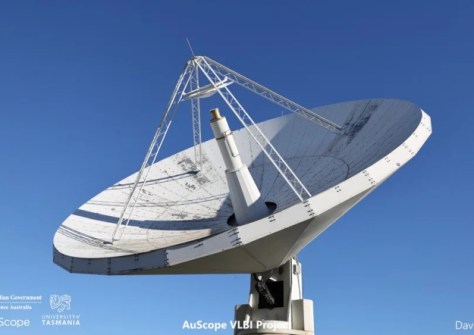
Australia has three VLBI stations — one near Hobart, another at Katherine and the third at Yarragadee in Western Australia.
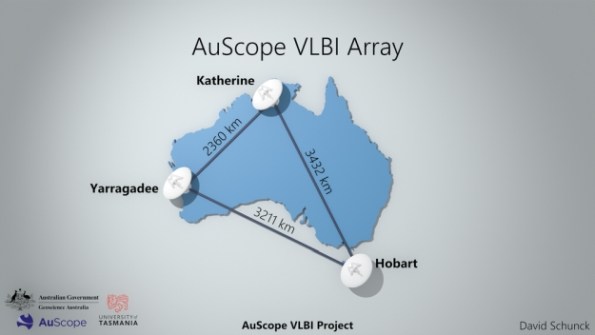
Together, they form the AuScope VLBI Array. Each telescope conducts several special geodetic observation sessions per week, with the Australian telescopes taking part in about 90% of all international geodetic VLBI experiments in 2025.
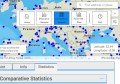
Indeed, in a ranking of the top 15 radio telescopes across globe in terms of total observing hours in 2025, the three Australian telescopes occupy the top three positions, each of them conducting between 3,000 and 4,000 hours of observations per annum.
This is a testament not only to Australia’s expertise in these matters, but also to the fortunate geographic placement of the three Array telescopes in the Southern Hemisphere.
The Australian data is processed by a ‘correlator’ hosted on the Gadi supercomputer in Canberra, part of the National Computational Infrastructure. Up to one petabyte of data is allocated for data processing.
Other topics that get a mention on the website include the International Celestial Reference Frame, the Earth orientation parameters, the International VLBI Service for Geodesy & Astrometry, and active galactic nuclei, the astronomical bodies the observation of which are at the heart of the whole effort.
The website was developed by Dr David Schunck and Dr Lucia McCallum from the geodetic VLBI research group at the University of Tasmania (UTAS), as part of an AuScope communication project conducted in collaboration with Geoscience Australia and UTAS.