An update on the bid for a national positioning, navigation and timing Co-operative Research Centre.
By Jonathan Nally
In about two months, a bid will be submitted to the federal government under its Co-operative Research Centre (CRC) program, for an institute to be set up to research and develop homegrown capabilities for protecting Australia’s crucial positioning, navigation and timing (PNT) ecosystem.
The bid for the Secure, Hardened, Integrity-Enhanced, Location and Timing Defence (SHIELD) CRC is being put together by a high-level consortium of academics and industry leaders.
And the need is urgent. All you have to do is read the recently released ANCHOR report from FrontierSI to see how vulnerable Australia is to PNT disruption and denial.
Such disturbances would likely take the form of interference with the GNSS, which, at heart, provides the vital timing ‘T’ in most PNT systems.
Such disruption would affect everyone in all sectors of life: transport, health, surveying, mining, finance, communications and so on. All are vulnerable.
As we reported two weeks ago, the ANCHOR report states that “Australia’s primary reliance on GPS can lead to critical points of failure, limited control over timing services, and potential supply chain choke points.”
It goes on to say that “Essentially, Australia’s PNT posture lacks the diversity, redundancy, resilience to manage contemporary threats that are both emerging and that can be layered across a continuum of strategic conditions (cooperation, competition, conflict).
“Adversaries could view Australia’s lack of PNT signal diversity as an opportunity to create disruption. Indeed, disruptions to PNT have become a routine modus operandi in the grey-zone state, and these only escalate and amplify during conflict.”
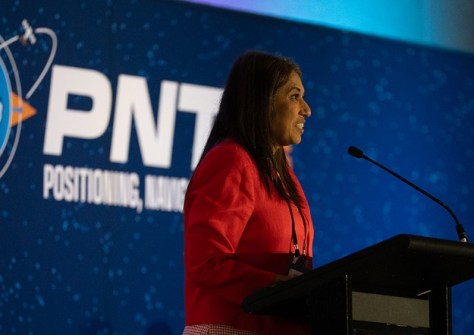
That’s where the need for the SHIELD CRC comes in. To find out more about the status of the bid and what the CRC will do if it is successful, we spoke with one of its leaders and interim CEO, Professor Allison Kealy from Swinburne University of Technology.
What is the SHIELD CRC all about?
It is about protecting critical infrastructure in Australia. The case we’re making is that productivity relies on business continuity, and anything that creates a vulnerability for critical infrastructure is going to affect that. So the CRC is about the steps we need to take, particularly when we think about vulnerabilities like those that can affect GNSS.
Because everyone in the geospatial sector relies on the GNSS.
It’s even broader than that. A lot of people don’t realise that things such as banking and electricity hinge off the same technology that delivers benefits to surveyors, farmers, to mining, telecoms, and so on. A failure doesn’t mean just one sector is affected; so it’s about looking at the cascading effects of those failures. And the message we’re trying to send is, that what we thought was going to be a hypothetical risk is now around us all the time because of geopolitical conflict.
I recently learned that on some cargo ships, if GPS goes out, the air conditioning and the ship’s horn stop working.
Yes, and that’s the real risk, that we don’t understand all the dependencies across critical systems.
You’ve run a series of industry briefings to get people on board with the bid. How did that go?
Really well. We’ve had a lot of interest from really diverse sectors, although, ironically, not many from the traditional PNT community. We’ve had great engagement with the timing community, with the alternative technology sectors, with the quantum people. It’s been really positive in terms of people signing up. We’ve got about $42 million of cash commitments over 10 years across government, industry and academia, and we’re hoping to get this up to about $55 million over the next couple of weeks.
And if successful, that amount would be matched by the federal government through the CRC funding?
Yes. We’re hoping to have something like $100 million total over 10 years by the time we’re finished.
That sounds like a staggering amount of money.
You’d be surprised how little you can do with that amount of money. If we were going to build a completely independent PNT system, is a $100 million enough? No, it’s not. So the challenge for us is to take the investments that are happening across the board and leverage it into the CRC so that we’re maximising the capital investments already being made.
So the CRC will be doing research, but it won’t itself set up any infrastructure or national timing systems?
No, our role is to design, validate and de-risk the sovereign technologies and architectures that both government and industry require. We will develop the demonstrators, standards pathways, integration frameworks and commercial models that enable agencies to operationalise resilient national timing systems — and enable industry to adopt and scale them across critical infrastructure sectors.
The UK is doing a lot of good things in this area. Do we need to emulate them?
This is a global problem. Other countries are taking their own steps to achieve sovereign and secure capability. We are working with and looking at the UK and the US to see what steps they are taking. The UK is leading the way right now in terms of its National Risk Register — the public version of the UK’s National Security Risk Assessment, which lists the PNT services as a significant risk — and the establishment of a National PNT office. We want to see Australia accelerate its efforts in addressing PNT vulnerabilities, because we think we’re already behind in some of these things.
Those countries are much closer to geopolitical hotspots. Do we need more urgency here in Australia?
The signals we are getting is that is considered urgent here as well. It’s not about getting people to be afraid or anything like that; it’s just about preparedness. The real question I ask people all the time is, ‘Who is responsible for PNT in Australia?’ And we don’t have an answer for it.
What’s the timeline from here?
The CRC funding round is about to open, so we’re looking to submit our bid around the end of April. If people out there are thinking this is important to them, now’s the time to get involved and get in touch — it’s not too late. Because our choice is to act now, when we can be preventative and proactive, or wait until it’s too late and we have to be reactive.