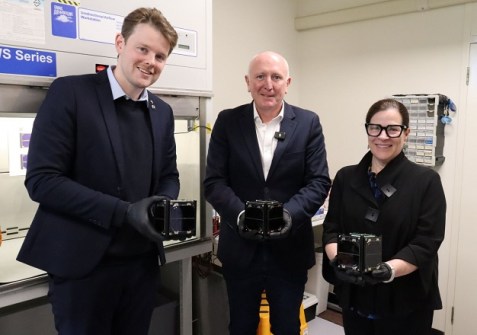
The Western Australia government has committed a total of $6.5 million for a homegrown satellite program and remote operations technology.
The four-year funding allocation comprises $2.5 million for the Curtin University-led Binar space program and $4 million for the AROSE consortium, which specialises in remote operations technology.
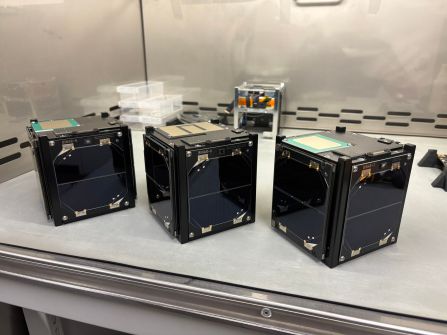
Begun in 2017, the Binar program has already seen the launch of four, 1U CubeSats. Pronounced ‘BIN-nah’, Binar is the Noongar word for ‘fireball’.
While it took three years to build and deliver Binar-1 and the Binar-2, -3 and -4 triplets, it has taken only 18 months to prepare Binar-5, -6 and -7. The three satellites are due for launch in November 2026.
The main objective of the Binar-7 CubeSat is to test a multispectral imaging system designed to monitor and assess the flammability of forested areas in Western Australia.
AROSE — Australian Remote Operations for Space and Earth — is a Perth-headquartered, not-for-profit, industry-led consortium developing and conducting remote operations both on Earth and in space.
Its efforts include national projects in bushfire detection and response, agriculture and defence, along with establishing new space and resources technology projects.
Binar program inspiring the next generation
One of the Binar program’s other aims is to act as an inspiration for Australia’s next generation of space scientists and technologists, via a heavy emphasis on high-school involvement.
“Thanks to the support of the state government, we’re going to continue training the next generation of the space workforce right here in WA, expand our research capabilities to develop more advanced engineering systems for small satellites and open our doors to industry to diversify their businesses and expand the state’s space industry,” said Binar Space Program Manager, Fergus Downey.
“Previous missions have taught us that space is relentless, and we’ve learnt a lot of valuable lessons about how to test and prepare our satellites for orbit, as well as how to train the next generation of satellite engineers to design systems to work in these environments.
“Our upcoming future missions will enable us to identify how we can support the WA industry to compete on the global stage and expand our research focus to bushfire prediction using satellite data.”
Curtin PhD student Mr Alex Conduit, aged 27, has worked with the Binar Space Program since he was an undergraduate mechatronic engineering student, and is continuing now that he is a postgraduate candidate.
“As a high school student interested in STEM, I would stare at the glow-in-the-dark stars on my bedroom ceiling and wonder how I might be able to help take humanity into space one day,” he said.
“Ever since working at the Binar Spare Program as an undergraduate student to now in my PhD, I have to pinch myself that I’m lucky enough to work with such a brilliant and talented team building WA’s space industry right here.”