The grandson of an Australian space sector pioneer has his sights set on his own space career, with the aim of improving data processing aboard Earth observation satellites.
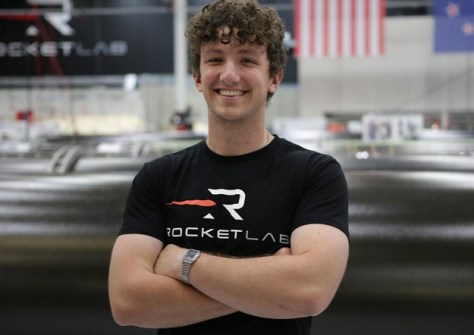
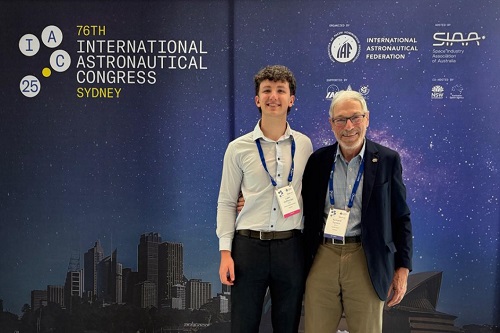
Liam Heffernan, a University of Queensland (UQ) Liveris Academy Scholar, will undertake his Masters study in Europe this year after being named a John Monash Scholar.
His grandfather, Richard Tonkin, was part of the team that produced the first satellite built in Australia, Australis OSCAR 5, in the 1960s.
“My grandfather’s been a huge inspiration to me and he’s particularly thrilled that I have the opportunity to follow my passion,” said Heffernan.
A space age family
Tonkin was doing a law degree at the University of Melbourne in the mid-1960s when he met members of the university’s astronautical society.
Together, they constructed a small amateur radio satellite made from bits and pieces such as springs and a builder’s tape measure, and launched it aboard a NASA Delta rocket in 1970.
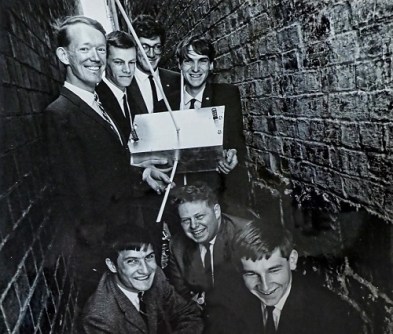
“At that time there was no space industry in Australia, so they reached out to an amateur radio satellite group in California to get it launched,” said Heffernan.
“Building those connections in countries with space programs remains incredibly important.
“The Australis group pioneered Australia’s presence in space, and I think their boldness and tenacity are a great example of how we can grow our industry.
“My grandfather’s been a huge inspiration to me and he’s particularly thrilled that I have the opportunity to follow my passion.”
The case for climate
Heffernan’s focus is on using machine learning to improve on-board data processing on spacecraft, particularly Earth observation satellites.
“Better and faster acquisition and delivery of data can vastly improve satellite functionality,” he said.
“In terms of Earth observation satellites, this could mean real-time imagery getting to first responders and policy makers during emergency events like bushfires.
“I’m a volunteer rural fire fighter, so this is something I particularly care about.
“Accurate information about fuel loads can help with prescribed burns, while imagery from a fire front can facilitate a faster emergency response.
“Climate resilience is just one of many ways satellites can be invaluable.”
A new space age career
Heffernan graduated from UQ’s Bachelor of Engineering (Honours) (Mechanical and Aerospace) program in 2025.
“As an undergraduate I studied overseas, at Purdue University in the US,” he said.
“I also interned on my holidays at Rocket Lab in New Zealand on their mechanical development team, and I’m headed back to work there for the first half of this year.
“That kind of industry experience and relationship building is invaluable.”
Later this year he will travel to Europe to begin his Masters in Mechanical Engineering.
“I’m excited to immerse myself in that ecosystem overseas, but my end goal is to bring my expertise home,” he said.
“I want to contribute and help grow Australia’s space industry.”